The Scope and Purpose of This Inspection Report
Purpose of the Commercial Purchase Walkthrough (A Limited Scope Inspection)
This limited scope inspection is a visual survey and a basic performance evaluation of the systems and components of the building exterior, mechanical systems, and a representative sampling of units/rooms. It provides information regarding the general condition of the plumbing, electrical, roofing, exterior, HVAC, and mechanical systems at the time the inspection was conducted. It is important that you carefully read ALL of the information in this report. Feel free to ask the inspector to clarify any items or comments that are unclear.
The inspector IS NOT required to:
- identify all potential hazards;
- turn on decommissioned equipment, systems, or utilities;
- climb over obstacles, move furnishings or stored items;
- prioritize or emphasize the importance of one deficiency over another;
- provide follow-up services to verify that proper repairs have been made;
- Provide commentary on systems that require a specialty designation.
Responsibility of the Client
While items identified as Concern, Repair, Maintenance, or Due Diligence in this inspection report DO NOT obligate any party to make repairs or take other actions, in the event that any further evaluations are needed, it is the responsibility of the client to obtain further evaluations and/or cost estimates from qualified service professionals regarding any items so classified. It is recommended that any further evaluations and/or cost estimates take place as soon as feasibly possible after delivery of the report, to mitigate any potential issues or ongoing damage.
Please Note: Evaluations performed by service professionals in response to items reported as Concern, Repair, Maintenance, or Due Diligence on the report may lead to the discovery of additional deficiencies that were not present, visible, or accessible at the time of the inspection. Any repairs made after the date of the inspection may render information contained in this report obsolete or invalid.
Report Limitations
This report is provided for the sole benefit of the client named and is based on observations made by the named inspector on the date the inspection was performed (indicated above).
ONLY those items specifically noted as being inspected on the report were inspected.
This inspection IS NOT:
- a technically exhaustive inspection of the structure, its systems, or its components and may not reveal all deficiencies;
- an inspection to verify compliance with any building codes;
- an inspection to verify compliance with manufacturer's installation instructions for any system or component and DOES NOT imply insurability or warrantability of the structure or its components.
NOTICE CONCERNING HAZARDOUS CONDITIONS, DEFICIENCIES, AND CONTRACTUAL AGREEMENTS
Conditions may be present in the home that did not violate building codes or common practices in effect when the home was constructed but are considered hazardous by today's standards. Such conditions that were part of the home prior to the adoption of any current codes prohibiting them may not be required to be updated to meet current code requirements. However, if it can be reasonably determined that they are present at the time of the inspection, the potential for injury or property loss from these conditions is significant enough to require inspectors to report them as items of Concern, Repair, Maintenance, or Due Diligence. Examples of such hazardous conditions include:
- malfunctioning, improperly installed, or missing ground fault circuit protection (GFCI) devices and arc-fault (AFCI) devices;
- ordinary glass in locations where modern construction requirements call for safety glass;
- malfunctioning or lack of fire safety features such as smoke alarms, fire-rated doors in certain locations, and functional emergency escape and rescue openings in bedrooms;
- malfunctioning or missing carbon monoxide alarms;
- excessive spacing between balusters on stairways and guard rails;
- improperly installed appliances;
- improperly installed or defective safety devices;
- lack of electrical bonding and grounding; and
- lack of bonding on gas piping, including corrugated stainless steel tubing (CSST).
Please Note: items identified as Concern, Repair, Maintenance, or Due Diligence in an inspection report DO NOT obligate any party to make repairs or take other actions. The decision to correct a hazard or any deficiency identified in an inspection report is left up to the party in legal control of the property.
How to Read This Report
Getting the Information to You
This report is designed to deliver important and technical information in a way that is easy for anyone to access and understand. If you are in a hurry, you can take a quick look at our "Summary Page” and quickly get critical information for important decision making. However, we strongly recommend that you take the time to read the full Report, which potentially includes digital photographs, diagrams, descriptions, videos, and links to additional information that do not show up in the summary.
The best way to get the layers of information that are presented in this report is to read your report online, which will allow you to expand your learning about your house. You will notice some words or series of words highlighted in blue and underlined – clicking on these will provide you with a link to additional information.
This report can also be printed on paper or to a PDF document.
Chapters and Sections
This report is divided into chapters that parcel the property into logical inspection components. Each chapter is broken into sections that relate to a specific system or component of the home. You can navigate between chapters with the click of a button on the left side margin.
Most sections will contain some descriptive information done in black font. Observation narrative, done in colored boxes, will be included if a system or component is found to be significantly deficient in some way or if we wish to provide helpful additional information about the system or the scope of our inspection. If a system or component of the home was deemed to be in satisfactory or serviceable condition, there may be no narrative observation comments in that section and it may simply say “tested,” or “inspected.”
Observation Labels
All narrative observations are colored, numbered and labeled to help you find, refer to, and understand the severity of the observation. Observation colors and labels used in this report are:
- Repair:Repair and urgent maintenance items noted during inspection. Please note that some repair items can be quite expensive to correct. Items identified in this category should be dealt with in a timely manner (less than 6 months) or they will likely turn into items of concern.
- Maintenance:These are routine items that are less urgent than repairs, and also don't pose an immediate safety risk. Maintenance items that get ignored WILL turn into items of repair or concern... Maintenance items should be addressed within the next 12-24 months.
- Due Diligence:Observations on items that are outside the scope of a general home inspection and require further investigation on your part to determine the severity and/or urgency of potential issues.
- Monitor:Items that do not currently appear to require action, but should be watched to see if action may be needed in the future.
- Informational:Detailed description of various aspects of the property noted during the inspection. Generally good stuff to know.
Summary Page
The Summary Page is designed as a bulleted overview of all the time sensitive observations noted during inspection. This helpful overview is not a substitution for reading the entire inspection report. The entire report must be read to get a complete understanding of this inspection report as the Summary Page does not include photographs, photo captions, or informational comments.
Summary
Repairs
- U-3 Utilities:
The abandoned, original heating appliance found to the east of the stage used to be fired with oil. It appears that there is still an in-ground oil tank, the vent pipe was located and found on the west side of the building. It is burping at the base of the vent pipe, that tank needs to be drained and decommissioned.
- SFBE-1 Structural Frame and Building Envelope:
The crawlspace is underneath the seating section of the theater, and requires some attention. There is no vapor barrier present, however, the dirt is so dry that it does not seem necessary.
There is evidence of rodent tunneling, however, there is no evidence of rodent harborag
There is no underfloor insulation, and this may be a contributing factor to why there are no signs of rodent infestation.
There is only limited access in this crawlspace, as the clearance becomes too tight for people to fit beneath the beams, if you wish additional access, some excavation of the dirt will be required for a full inspection.
- SFBE-2 Structural Frame and Building Envelope:
There are a small locations on the side walls and the rear wall where the barge coating has broken free, exposing the brick beneath. Brick and mortar are subject to erosion from the elements, and need to be protected. Qualified Mason should be retained to review the exterior envelope and repair as needed to restore the rain screen protecting the underlying masonry.
- MES-1 Mechanical and Electrical System:
In the basement of the theater, there appears to be a plumbing vent that has been disconnected from its stack, it should be reconnected with a Fernco fitting. On the roof above Daphne's, the plumbing vent has slipped down to the point where it rain will fill the pipe and block the vent. The pipe should be elevated enough that any rain that gets into the vent will drain back down the pipe.
- MES-3 Mechanical and Electrical System:
Old abandoned heating equipment is covered in what appears to be asbestos. Identification of asbestos containing materials is beyond the scope of this inspection, however, prior to dismantling and removal of this equipment you should have it tested so that proper safeguards can be utilized.
This is backstage NE
- MES-5 Mechanical and Electrical System:
The condensate drain is leaking inside the wall, this can cause damage to the structure. The drain pipe should be repaired so that it positively drains on the exterior.
- MES-7 Mechanical and Electrical System:
In the attic and crawlspaces, there were noted multiple junction boxes that were missing their covers. Also, in the attic, knob to boring was noted to be buried in the insulation. A licensed electrician should be retained to review the entire system and make repairs as necessary to assure safety. These repairs may include rewiring some of the knob tube circuits.
Maintenance Items
- GPC-1 General Physical Condition :
Roof runoff is managed through downspouts that dump directly onto city property. The scuppers in the parapet roof need to be cleaned.
- SFBE-3 Structural Frame and Building Envelope:
Organic matter that has caught behind the parapet walls and in the gutter/runoff control system needs to be removed.
This should take place at least annually, if not more more often.
Due Diligence Items
- U-1 Utilities:
The primary water shut off valve was not located during this inspection. An inquiry should be made of the current facilities manager to determine whether or not there is an accessible shut off inside the building, or if it is controlled at the meter.
- U-2 Utilities:
The building is equipped with modern circuit breakers, an upgrade from when it was originally built. However, some of the electrical distribution wire is still knob and tube wiring. The knob and tube wiring was primarily found in the attic, but there may also be some in the crawlspace.
- MES-4 Mechanical and Electrical System:
You should verify during your inspection contingency that this equipment is on a routine maintenance schedule. This inspection, is limited to identifying the type of heating provided. Verification of the condition of the equipment is not within the scope of this inspection, you should have the equipment reviewed by a specialist.
- MES-6 Mechanical and Electrical System:
It appears that the theatre and Daphne's may be separately metered... this can be verified by calling the PUD.
- AT2S-1 ADA Tier 2 Survey:
It should be noted that this building does not comply with the majority of ADA requirements. Any upgrades/remodeling to this building will likely require ADA compliance to be part of the design.
Consult an architect to determine feasibility of ADA and other code required upgrades.
Items To Monitor
- MES-2 Mechanical and Electrical System:
The water heater under the theater concession area is approaching the end of its design life. Typically when water heaters reach between 15 to 17 years, they should be replaced before they fail.
This heater was installed in 2011.
Your Optimized Commercial Building Report
Structural Frame and Building Envelope
Styles and Materials
Foundation
Crawlspace
Facades or Curtain Wall (The principal face of the building)
Sidewall System (exterior wall cladding and components)
Roofing
General Physical Condition
Styles and Materials
General Topography: Flat
Storm Water Drainage: Above Ground
Access and Egress: City Street
Paving Curbing Parking: No dedicated parking
Storm Water Drainage
Roof runoff is managed through downspouts that dump directly onto city property. The scuppers in the parapet roof need to be cleaned.
 |  |
Utilities
Styles and Materials
Water Source: Public Utility
Electric source: Public Utility
Gas supply: Natural Gas
Sanitary Sewer: Public sewer system (scoped)
Storm Sewer: N/A
Water
The primary water shut off valve was not located during this inspection. An inquiry should be made of the current facilities manager to determine whether or not there is an accessible shut off inside the building, or if it is controlled at the meter.
Electricity
The building is equipped with modern circuit breakers, an upgrade from when it was originally built. However, some of the electrical distribution wire is still knob and tube wiring. The knob and tube wiring was primarily found in the attic, but there may also be some in the crawlspace.
Natural gas
The abandoned, original heating appliance found to the east of the stage used to be fired with oil. It appears that there is still an in-ground oil tank, the vent pipe was located and found on the west side of the building. It is burping at the base of the vent pipe, that tank needs to be drained and decommissioned.
 |  |
The gas meter is located at the rear of the building, on the north side.

Sanitary Sewer
The sewer line was scoped from the cleanout accessible in the downstairs washroom of Daphne's bar. No items requiring repair were found during this inspection. When you are watching the video, please have volume turned up, since I narrate what I am seeing. If you have any questions, please feel free to reach out.



Structural Frame and Building Envelope
Styles and Materials
Foundation: Concrete
Method used to observe Crawlspace Cellars or Basement: Limited access
Building Type: Brick
Roof-Type: Gambrel
Roof Structure: 2 X 4 Rafters, Beams, Lateral bracing
Method used to observe attic: Walked
Attic info: Scuttle hole, No Storage
Attic Insulation: Blown, Fiberglass
Exterior Entry Doors: Wood, Insulated glass, Panic bar
Siding Style: Parge Coating over Brick
Roof Covering: Roll/Selvage
Viewed roof covering from: Drone
Foundation
Very little of the foundation is visible, since the majority of it is below grade. Visible portions of the foundation were verified to be concrete.
Crawlspace
The crawlspace is underneath the seating section of the theater, and requires some attention. There is no vapor barrier present, however, the dirt is so dry that it does not seem necessary.
There is evidence of rodent tunneling, however, there is no evidence of rodent harborag
There is no underfloor insulation, and this may be a contributing factor to why there are no signs of rodent infestation.
There is only limited access in this crawlspace, as the clearance becomes too tight for people to fit beneath the beams, if you wish additional access, some excavation of the dirt will be required for a full inspection.
 |  |  |
 |  |  |
 |  |  |
Facades or Curtain Wall (The principal face of the building)
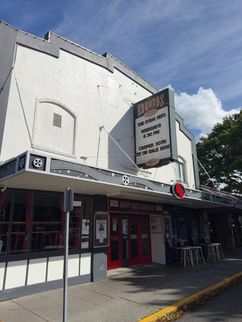
The street facing side of the building is well-maintained, and no needs for immediate repair were noted.
Sidewall System (exterior wall cladding and components)
There are a small locations on the side walls and the rear wall where the barge coating has broken free, exposing the brick beneath. Brick and mortar are subject to erosion from the elements, and need to be protected. Qualified Mason should be retained to review the exterior envelope and repair as needed to restore the rain screen protecting the underlying masonry.


 |  |  |
 | ||

Roofing
Organic matter that has caught behind the parapet walls and in the gutter/runoff control system needs to be removed.
This should take place at least annually, if not more more often.
 |  |  |
 |
The roof appears to be in satisfactory condition. Roofs made of this material, do require maintenance. Every once in a while, it should be on a regular schedule of inspection until replaced.
 |  |  |
 |  |
Mechanical and Electrical System
Styles and Materials
Plumbing Water Supply (into building): Copper
Plumbing Water Distribution (inside building): Copper
Plumbing Waste: ABS, Cast iron
Water Heater Power Source: Electric
Water Heater Capacity: 50 Gallon (2-3 people)
Water Heater Manufacturer: GE
Water Heater Location: Basement
Heat Type: Heat Pump Forced Air (also provides cool air)
Number of Heat Systems (excluding wood): One
Energy Source for Heat: Electric
Heat System Brand: TRANE
Ductwork: Non-insulated, Possible asbestos tape
Cooling Equipment Type: Heat Pump Forced Air (also provides warm air)
Cooling Equipment Energy Source: Electricity
Central Air Manufacturer: TRANE
Electrical Service Conductors: Overhead service
Units individually metered (Electrical): No
Panel capacity: 200 AMP
Panel Type: Circuit breakers
Electric Panel Manufacturer: SQUARE D
Vertical Transportation Type: None
Plumbing water supply and Distribution and Fixtures
The plumbing supply system appears to be all updated at this point (copper and PEX were noted).
 |  |  |
 |
Plumbing Drain, Waste and Vent Systems
In the basement of the theater, there appears to be a plumbing vent that has been disconnected from its stack, it should be reconnected with a Fernco fitting. On the roof above Daphne's, the plumbing vent has slipped down to the point where it rain will fill the pipe and block the vent. The pipe should be elevated enough that any rain that gets into the vent will drain back down the pipe.


Domestic hot water production
The water heater under the theater concession area is approaching the end of its design life. Typically when water heaters reach between 15 to 17 years, they should be replaced before they fail.
This heater was installed in 2011.
 |  |
Heating Equipment
Old abandoned heating equipment is covered in what appears to be asbestos. Identification of asbestos containing materials is beyond the scope of this inspection, however, prior to dismantling and removal of this equipment you should have it tested so that proper safeguards can be utilized.
This is backstage NE
 |  |  |
 |  |
Air conditioning and Ventilation
You should verify during your inspection contingency that this equipment is on a routine maintenance schedule. This inspection, is limited to identifying the type of heating provided. Verification of the condition of the equipment is not within the scope of this inspection, you should have the equipment reviewed by a specialist.
 |  |  |
 |  |  |
The condensate drain is leaking inside the wall, this can cause damage to the structure. The drain pipe should be repaired so that it positively drains on the exterior.

Electric Service and Meter
It appears that the theatre and Daphne's may be separately metered... this can be verified by calling the PUD.

Electric Distribution
The coverage were not removed off of the electrical panels during this inspection. Here are photos of all of the permit stickers found during this inspection.
 |  |  |
 |  |  |
In the attic and crawlspaces, there were noted multiple junction boxes that were missing their covers. Also, in the attic, knob to boring was noted to be buried in the insulation. A licensed electrician should be retained to review the entire system and make repairs as necessary to assure safety. These repairs may include rewiring some of the knob tube circuits.


Fire Protection
Styles and Materials
Sprinkler system: N/A
Standpipes: N/A
Fire Hydrant: Yes nearby property
Fire Alarm system: None Noted
ADA Tier 2 Survey
Overview of The Americans with Disabilities Act
It should be noted that this building does not comply with the majority of ADA requirements. Any upgrades/remodeling to this building will likely require ADA compliance to be part of the design.
Consult an architect to determine feasibility of ADA and other code required upgrades.
 |  |
The Americans with Disabilities Act is a civil rights law that was enacted in 1990 to
provide persons with disabilities with accommodations and access equal to, or similar
to, that available to the general public. Title III of the ADA requires that owners of
buildings that are considered to be places of public accommodations remove
those architectural barriers and communications barriers that are considered
readily achievable in accordance with the resources available to building
ownership to allow use of the facility by the disabled. The obligation to remove
barriers where readily achievable is an ongoing one. The determination as to whether
removal of a barrier or an implementation of a component or system is readily achievable
is often a business decision, which is based on the resources available to the owner or
tenants, and contingent upon the timing of implementation as well. Determination of
whether barrier removal is readily achievable is on a case-by-case basis; the United
States Department of Justice did not provide numerical formulas or thresholds of any
kind to determine whether an action is readily achievable.
Overview of the Americans with Disabilities Act Accessibility Guidelines (ADAAG)
As required by the ADA, the U.S. Architectural and Transportation Barriers Compliance
Board promulgated the Americans with Disabilities Act Accessibility Guidelines.
ADAAG provides guidelines for implementation of the ADA by providing specifications for
design, construction, and alteration of facilities in accordance with the ADA. These
guidelines specify quantities, sizes, dimensions, spacing, and locations of various
components of a facility so as to be in compliance with the ADA.
Variable Levels of Due Diligence: For many users, especially those acquiring or
taking an equity interest in a property, a complete accessibility survey in accordance
with ADAAG may be desired. For other users, however, an abbreviated accessibility
survey may serve to identify most of the major costs to realize ADA compliance without
assessing every accessible element and space within and without a facility, and without
taking measurements and counts. Any accessibility survey should be based on
ADAAG, however. There are three tiers of ADA due diligence, which may be
supplemented or revised in accordance with the user’s risk tolerance level for ADA
deficiencies and the resulting costs to realize compliance. These tiers are: Tier I-Visual
Accessibility Survey (a limited scope visual survey, which excludes the taking of
measurements or counts); Tier II-Abbreviated Accessibility Survey (an abbreviated
scope survey entailing the taking of limited measurements and counts); and Tier III-Full Accessibility Survey in compliance with ADAAG. ADAAG provides guidance
only concerning federal requirements for ADA compliance. Some states and
localities may have additional compliance requirements that will not be addressed by
any of the levels of due diligence enumerated in this document. The user may desire a
site-specific accessibility survey, in some instances.
This inspection does not qualify for ADA compliance verification.
Guest Rooms
Repair Issues Noted In Rooms
The following issues were noted in 2nd Floor Rooms # 212, 213, 215, 217, 221: : .
.
Signed Contracts
Optimized Inspection Services, LLC.
206-349-0733
OptimizedInspections.com
bryanm@optimizedinspections.com
750