The Scope and Purpose of a Home Inspection
Purchasing property involves risk
The purpose of a home inspection is to help reduce the risk associated with the purchase of a structure by providing a professional opinion about the overall condition of the structure. A home inspection is a limited visual inspection, and it cannot eliminate this risk. Some homes present more risks than others. We cannot control this, but we try to help educate you about what we don’t know during the inspection process. This is more difficult to convey in a report and one of many reasons why we recommend you attend the inspection.
A home inspection is not an insurance policy
This report does not substitute for or serve as a warranty or guarantee. Home warranties can be purchased separately from insuring firms that provide this service.
A home inspection is visual and not destructive
The descriptions and observations in this report are based on a visual inspection of the structure. We inspect the aspects of the structure that can be viewed without dismantling, damaging, or disfiguring the structure and without moving furniture and interior furnishings. Areas that are concealed, hidden, or inaccessible to view are not covered by this inspection. Some systems cannot be tested during this inspection as testing risks damaging the building. For example, overflow drains on bathtubs are generally not tested because if they were found to be leaking, they could damage the finishes below. Our procedures involve non-invasive investigation and non-destructive testing, which will limit the scope of the inspection.
This is not an inspection for code compliance
This inspection and report are not intended for city / local code compliance. During the construction, process structures are inspected for code compliance by municipal inspectors. Framing is open at this time, and conditions can be fully viewed. Framing is not open during inspections of finished homes, limiting the inspection. All houses fall out of code compliance shortly after they are built, as the codes continually change. National codes are augmented at least every three years for all disciplines. Municipalities can adopt and phase in sections of the codes on their timetables. There are generally no requirements to bring older homes into compliance unless substantial renovation is being done.
This is just our opinion
Construction techniques and standards vary. There is no one way to build a house or install a system in a house. The observations in this report are the opinions of the home inspector. Other inspectors and contractors are likely to have some differing opinions. You are welcome to seek opinions from other professionals.
The scope of this inspection
This inspection will include the following systems: exterior, roof, structure, drainage, foundation, attic, interior, plumbing, electrical, and heating. The evaluation will be based on limited observations that are primarily visual and non-invasive. This inspection and report are not intended to be technically exhaustive.
Your expectations
The overall goal of a home inspection is to help ensure that your expectations are appropriate for the house you are proposing to buy. To this end, we assist with the discovery by showing and documenting observations during the home inspection. This should not be mistaken for a technically exhaustive inspection designed to uncover every defect in a building. Such inspections are available, but they are generally cost-prohibitive to most homebuyers.
Your participation is requested
Your presence is requested during this inspection. A written report will not substitute for all the possible information that can be conveyed verbally by a shared visual observation of the conditions of the property.
How to Read This Report
Getting the Information to You
This report is designed to deliver important and technical information in a way that is easy for anyone to access and understand. If you are in a hurry, you can take a quick look at our "Summary Page” and quickly get the critical information for important decision-making. However, we strongly recommend that you take the time to read the full Report, which includes digital photographs, captions, diagrams, descriptions, videos, and hot links to additional information.
The best way to get the layers of information presented in this report is to read your report online, which will allow you to expand your learning about your house. You will notice some words or series of words highlighted in blue and underlined – clicking on these will provide you with additional information.
This report can also be printed to a PDF file and printed on paper as desired.
Chapters and Sections
This report is divided into chapters that parcel the home into logical inspection components. Each chapter is broken into sections that relate to a specific system or component of the home. You can navigate between chapters with the click of a button on the left-side margin.
Most sections will contain some descriptive information in black font. Observation narrative, done in colored boxes, will be included if a system or component is found to be significantly deficient in some way or if we wish to provide helpful additional information about the system or the scope of our inspection. If a system or component of the home was deemed to be in satisfactory or serviceable condition, there might be no narrative observation comments in that section, and it may simply say “tested” or “inspected.”
Observation Labels
All narrative observations are colored, numbered, and labeled to help you find, refer to, and understand the severity of the observation. Observation colors and labels used in this report are:
- Major Concern:Repair items that may cost significant money to correct now or in the near future, or items that require immediate attention to prevent additional damage or eliminate safety hazards.
- Repair:Repair and maintenance items noted during inspection. Please note that some repair items can be expensive to correct such as re-finishing hardwood floors, but are considered simply repair items due to their cosmetic nature.
- Recommended Maintenance:These are repair items that should be considered "routine home ownership items," such as servicing the furnace, cleaning the gutters or changing the air filters in the furnace.
- Incomplete:Items that have not been completed.
- Improve or Upgrade:Observations that are not necessarily defects, but which could be improved for safety, efficiency, or reliability reasons. These are often items which reflect changes in building codes or standards.
- Due Diligence:Observation such as a buried oil tank that may require further investigation to determine the severity and / or urgency of repair.
- Monitor:Items that should be watched to see if correction may be needed in the future.
- Future Project:A repair that may be deferred for some time but should be on the radar for repair or replacement in the near future.
- Inspection Notes:Aside information and /or comments elaborating on descriptions of systems in the home that the inspector might find useful to purchase decisions or home ownership. .
- Limitations:Conditions present at the time of inspection which limited the scope of this visual inspection
Summary Page
The Summary Page is designed as a bulleted overview of all the observations noted during the inspection. This helpful overview is not a substitute for reading the entire inspection report. The entire report must be read to get a complete understanding of this inspection report, as the Summary Page does not include photographs or photo captions.
Moisture Meter Testing
Where moisture meter testing is indicated in this report, a Protimiter Survey Master Dual Function was used.
Summary
Major Concerns
- SAB-3 STRUCTURE AND BASEMENT - Floor, Wall and Ceiling Framing:
WOOD PONY WALL BELOW GRADE AND FAILING METAL FLASHING
There is an unusual configuration with a wood wall installed between the crawl space and the garage slab. This wall looks to be below grade and the metal material that is between the soils and the wood is corroded and failing. The wood wall does not seem damaged at this time, but the metal is no longer reliable and could be difficult to replace.
Recommendation
I recommend additional inspection of this configuration by a qualified contractor. Implement repairs as recommended. Please note that additional inspection is needed to determine an accurate scope and urgency for repair.
Repairs
- EDAF-1 ELECTRIC DISTRIBUTION AND FIXTURES - Branch Wiring:
ABANDONED WIRING NOTED
Abandoned wiring was noted in the crawl space This should be eliminated or properly terminated inside a listed junction box. It is often not feasible to determine if wire is still connected to a power source. I can test these with a voltage sensor, but they could be shut off by a switch or temporarily disconnected. For optimal safety, all abandoned wires should be eliminated or properly terminated inside a junction box.
- EDAF-2 ELECTRIC DISTRIBUTION AND FIXTURES - Branch Wiring:
WIRING SUPPORT AND RESTRAINT NEEDED
The non-metallic sheathed cable is poorly supported and requires staples or hangers for additional support and strain relief - see crawl space. This type of wiring should be supported every 4 feet and within 2 feet of junction boxes.
✒️
- Smaller cables in crawl spaces and unfinished basements shall be run either through bored holes in joists or on running boards.
- HCFAV-10 HEATING, COOLING, FIREPLACES, AND VENTILATION - Mechanical Ventilation Systems:
CORRUGATED KITCHEN EXHAUST VENT PIPE
The kitchen fan duct is done using corrugated pipe. The kitchen fan vent pipe should be smooth wall only so it can be cleaned to prevent grease build-up which can be a fire hazard.
- HB-3 HALL BATHROOM - Bathtub / Shower:
INADEQUATE HOT WATER TEMPERATURES IN SHOWERS
I did not get adequate hot water when testing the bathroom showers on the main floor. Building standards do not consider water hot until at least 100 degrees F. I generally expect that fixtures, when tested in full hot, should provide hot water to roughly 120 degrees F, though this can vary by the fixture's proximity to the water heater. Hot water at any given fixture should never exceed 120 degrees F. I recommend additional inspection of these shower fixtures by a qualified plumbing contractor. Repair could necessitate adjustment of the water heater or downstream mixing valves or possibly even eliminating redundant mixing valves.
Bathroom LocationsPrimary BathroomHall Bathroom - CS-4 CRAWL SPACE - Insulation:
CRAWL SPACE INSULATION REPAIR
The subfloor insulation in the crawl space requires tune-up repair. Secure all loose and sagging insulation.
Recommendation
Replace insulation where missing. Ensure the entire subfloor is insulated.
✒️
- When making repairs, check all penetrations through the floor; it is best to seal any noticeable air leaks between the crawl space and the living space.
Recommended Maintenance
- G1-1 GROUNDS - Drainage and Site:
DOWNSPOUTS DISCHARGE NEAR FOUNDATION
Downspouts discharge adjacent to the foundation, which can cause foundation settlement or crawl space moisture problems. Make sure all downspouts discharge into a proper, tight-line system that diverts water at least 5 feet away from the foundation.
✒️
- Splash blocks have been used here but these may be inadequate.
- No water was noted in the crawl space at the time of the inspection.
- RCAG-4 ROOF CHIMNEYS AND GUTTERS - Gutters and Downspouts:
GUTTER CLEANING NEEDED
The gutters are clogged with organic debris and require cleaning to ensure proper control of roof runoff. Clean the gutters and ensure they are unobstructed, leak-free and properly sloped to drain. This is routine house maintenance; I would expect the need to clean gutters and downspouts regularly.
- The roof and gutters both need cleaning. This will be regular maintenance with all the trees around.
- HCFAV-6 HEATING, COOLING, FIREPLACES, AND VENTILATION - Heat Pumps and Cooling Systems:
SERVICING THE HEAT PUMP
Heating and cooling contractors recommend annual servicing of heat pump systems to maximize the useful life and efficiency of heating and cooling equipment. In addition, heat pump systems should be serviced after new construction to be sure the ducts and air handler are free of construction materials. I recommend having this system serviced and further evaluated by a qualified heating contractor. The system was tested in heating mode during inspection and responded well to normal operating controls. Examples of testing procedures and observations noted during inspection include:
- The system seems to have a few zones and zone control dampers were noted.
- Zone control dampers were noted on the ducts
- The compressor was operating well.
- The blower fan was nice and clean
- The air filter has not been changed for roughly 8 months.
- HCFAV-8 HEATING, COOLING, FIREPLACES, AND VENTILATION - Heating and Cooling Distribution Systems:
EXPOSED FIBERGLASS ON THE HVAC DUCTS IN THE GARAGE
The ducts in this area are subject to physical damage. Covering the fiberglass is recommended to reduce airborne fiberglass and protect the insulation.
- K-2 KITCHEN - Dishwasher:
NO WATER HAMMER ARRESTOR WAS FOUND - DISHWASHER
Water hammer arrestors are required where quick closing valves are utilized - this is most dishwashers and washing machines. Installation of a hammer arrestor device is recommended for improved reliability of the piping system.
- RPAWDO-2 RODENTS, PESTS, AND WOOD DESTROYING ORGANISMS - Wood Destroying Organisms:
REMOVE CELLULOSE AND CONSTRUCTION DEBRIS FROM THE CRAWL SPACE
Wood and cellulose debris were noted in the crawl space. This can encourage wood-destroying organisms such as subterranean termites. Removal of all cellulose debris from the crawl space is recommended to eliminate conditions conducive to wood-destroying organisms. This should include the removal of all construction materials and wood debris.
Incomplete Items
- E-2 EXTERIOR - Siding and Trim:
SEAL UP HOLES IN SIDING
Holes were noted in the siding system that require sealing to prevent water and air infiltration and potential paths for insect or rodent entry. Seal and paint as needed to block these openings.
- Be sure to seal up the holes in the siding on the heat pump side of the building where the low voltage lines come through.
- G-1 GARAGE - Garage Doors and Automatic Openers:
OVERHEAD GARAGE DOOR REPAIRS / SERVICING
A few repairs are needed to the overhead garage door system. Observations noted during the inspection include:
Wall Control
- Missing warning label at wall control, advising occupants to keep controls out of reach of children.
- Loose wall control.
Recommendation
Have the overhead garage door system serviced and serviced and repaired as recommended by a specialist to ensure safe and reliable performance.
- I-2 INTERIOR - Interior Doors:
DOOR REPAIRS NEEDED
A number of repairs are needed for the doors in this building. Examples of observations noted during the inspection include:
- The door to the northeast bedroom on the main floor is not latching
- The backs of a number of the second floor bifold doors have not been sanded. They're very scratchy.
Recommendation
Hire a qualified general contractor to further evaluate and repair/adjust interior doors for reliable performance.
- K-4 KITCHEN - Ranges, Ovens and Cooktops:
BURN OFF THE OVEN
Burning off the new oven is recommended to eliminate smoking and odor during operation. New ovens will always produce acrid smoke during the first use. Running for several hours prior to use and ventilating the space and help get this new appliance ready for daily use.
- K-6 KITCHEN - Refrigerators:
THE BEVERAGE REFRIGERATOR TEMPERATURE WAS NOT SET
Have this set and made operable as needed.
- GB-2 GUEST BATHROOM - Sinks and Cabinets:
CABINET ADJUSTMENT
The cabinet door is hitting the base trim in the guest bathroom - adjust as needed.
Improve Or Upgrade Items
- P-2 PLUMBING - Water Service Supply:
CONSIDER A FLOW SENSOR ON THE MAIN WATER PIPE
A Flo water sensor should be considered to protect the building. These are smart home technologies that can monitor the house for leaks and shut the water to the home off in case leaks are detected.
- L-3 LAUNDRY - Washer:
MOISTURE ALARM RECOMMENDED
A moisture alarm with water shut-off features is recommended under the washing machine to protect against accidental leaks in the supply hoses. Pans can be effective when there is a drain, but even these will not protect against a burst supply connector. A moisture alarm with automatic shut-off will. Watts is a brand I have seen installed: Link. Please also note that appliance manufacturers recommend replacing supply hoses every 5 years to reduce the risk of failure.
- CS-3 CRAWL SPACE - Vapor Barrier:
OLD VAPOR BARRIER
The vapor barrier here is old and covered in saw dust and debris. It seems to be mostly intact but was not updated during recent renovation work.
Due Diligence Items
- E-3 EXTERIOR - Siding and Trim:
FIBER CEMENT SIDING LACKS QUARTER INCH GAP
In places, the siding does not have a proper gap between the trim and the siding as recommended by today's installation standards for fiber cement siding; see the gap between panels. This is likely not cost-effective to correct but could cause long-term damage to the siding. Have this further investigated by a qualified siding contractor and repair as feasible.
- RCAG-3 ROOF CHIMNEYS AND GUTTERS - Roof Materials:
NEW ROOF NOTED
The roofing material on this building is a recently installed dimensional or architectural-grade shingle. The installation appears neat and professional.
Recommendation
Inquire with the seller about any warranty and/or installer information for this new roof covering installation.
✒️
- These are often rated as 30-40-year shingles. In practice, as a roof assembly, these tend to last about 18-23 years, depending on the quality of the installation, the steepness of the roof, and the exposure.
- Many professional roofing companies will offer limited workmanship warranties. Please note that roofs are not a shingle; they are an assembly, and they require regular cleaning and maintenance to keep them performing reliably.
- EDAF-8 ELECTRIC DISTRIBUTION AND FIXTURES - Low Voltage Wiring:
INQUIRE WITH THE BUILDER ABOUT LOW VOLTAGE WIRING CONNECTIONS SUCH AS CATV AND PHONE
It is normal for the builder to run all of there wires to the exterior and leave them in a bundle. When services are ordered such as CATV, the utility will often provide the box and make the connection to the house wiring.
✒️
- Verify from the builder that the utility side of the service has been run to the building.
- Please note that inspection of low voltage wiring is beyond the scope of this inspection.
- It looks as though they ran low voltage wiring to the storage shed? Is this for power too?
- P-8 PLUMBING - Waste Pipe and Discharge:
ONSITE SEPTIC SYSTEM
Based on visible components, this property appears to have a private on-site septic system. These are specialty systems and are excluded from this inspection. Comments in this report related to this system are made as a courtesy only and are not meant to be a substitute for a full evaluation by a qualified specialist. Generally, septic tanks should be pumped and inspected every 3 years. Depending on the type of system and municipal regulations, inspection and maintenance may be required more frequently, often annually. I recommend:
- Investigating any information about this system's maintenance and repair history
- Reviewing any documentation available for this system
- Learning inspection and maintenance requirements for this system
- Hire a qualified specialist to evaluate, perform maintenance and make repairs as needed
- AP-1 ADDITIONAL PLUMBING - Irrigation:
IRRIGATION SYSTEM NOTED
An exterior irrigation system was noted for this yard. Sprinkler systems are beyond the scope of this inspection. My own experience with irrigation systems is that they require annual attention/repair/servicing after every winter.
Recommendation
Inquire with the seller for any information about winterizing this system, as this should be done before cold weather. When testing the system, be sure sprinkler heads are adjusted so the system is not watering the side of the house. Hire a specialist to evaluate this system further as desired.
- L-4 LAUNDRY - Washer:
ROUGHED IN LAUNDRY FACILITIES
It looks as though a 2nd laundry facility has been roughed in for this building. Inquire with the seller regarding any additional information.
- SAB-2 STRUCTURE AND BASEMENT - Foundation:
HAS SEISMIC RETROFFITING WORK BEEN DONE
Inquire with the builder if any seismic retrofitting work was done during renovations to the building.
- RPAWDO-1 RODENTS, PESTS, AND WOOD DESTROYING ORGANISMS - Rodents:
RODENT TRAPS NOTED
Rodent traps were found in the crawl space. No feces were noted during the inspection. Inquire with the seller regarding any history of rodent problems. Please note that ongoing baiting and trapping is always recommended as rodent control is a constant part of home ownership.
Items for Monitoring
- G1-2 GROUNDS - Drainage and Site:
CORRUGATED SUBSURFACE DRAIN PIPE NOTED
This is a common product that can have limited useful service life. These drains are designed to capture roof runoff and divert the water away from the building. This pipe cannot be reliably cleaned due to the corrugations and softer plastic. It is generally more prone to clogging and crushing. No signs of failure were noted during the inspection. Monitor during heavy rains.
- P-10 PLUMBING - Exterior Hose Bibs:
BE SURE TO WINTERIZE HOSE BIBS PRIOR TO FREEZING WEATHER
These hot and cold hose bibs should be winterized during cold weather to prevent freezing.
Future Projects
- E-4 EXTERIOR - Siding and Trim:
SIDING MOUNTING BLOCKS MISSING
Some of the penetrations in the siding lack adequate mounting blocks. For penetrations in the building envelope such as hose bibs and holes with a 1½ inch diameter or larger, such as dryer vents, a block shall be installed around the point of penetration. Blocking should be a minimum 3 in.. radius greater than the radius of the penetration. The main purpose of mounting blocks is so that if termination covers, such as a fan cover, are broken or damaged, they can be replaced without needing to dismantle the exterior siding system.
✒️
- To install a block around an existing penetration, it may be necessary to cut the block into two pieces. If you wish to correct this, weather-cut the trim to fit it into place. Install flashing over the top of the trim block. Penetrations through a building envelope are made to accommodate needs such as hose bibs, dryer and furnace vents, electrical conduit, etc. It is important to restore the weather-resistant barrier of the home after cutting a hole for the penetration.
📸 The Complete Report
GROUNDS
Address Identification
Drainage and Site
Window and Stairwells
Driveways/Walkways/Flatwork
Grounds, Trees and Vegetation
Exterior Stairs
Retaining Walls
Fences
Outbuildings, Trellises, Storage Sheds, Barns
DECKS PORCHES AND BALCONIES
Wood Decks Porches and Balconies
Concrete Decks, Stoops, Landings and Porches
Water-Resistant Decks and Balconies
Metal Decks and Balconies
GARAGE
Garage General
Garage Doors and Automatic Openers
Garage Floor
Garage Stairs
Garage Electric
Electric Vehicle Power Supply
ELECTRIC SERVICE
Electric Service Permits Found
Electric Service Voltage Tested
Electric Service
Electric Service Equipment
Sub Panel
Generator Equipment
Appliance Disconnects
Electrical Grounding System
Electrical Bonding System
ELECTRIC DISTRIBUTION AND FIXTURES
Branch Wiring
Receptacles and Fixtures
Smoke and Carbon Monoxide Alarm Systems
Ceiling Fans
Low Voltage Wiring
HEATING, COOLING, FIREPLACES, AND VENTILATION
Heating Systems
Heat Pumps and Cooling Systems
Vents and Flues
Air Filters
Heating and Cooling Distribution Systems
Mechanical Ventilation Systems
Additional Heat Sources
Gas Fireplaces
Solid Fuel Fireplaces
PLUMBING
Water Service Supply
Distribution Pipe
Waste Pipe and Discharge
Exterior Hose Bibs
Sump Pumps and Drains
Sewage Ejector Pumps
INTERIOR
Floors and Floor Materials
Walls, Ceilings, Trim, Hallways and Closets
Wall Insulation and Air Bypass
Interior Stairs and Railings
Interior Doors
Windows
KITCHEN
General Kitchen Photos
Sinks and Faucets
Cabinets and Countertops
Disposers
Dishwasher
Ventilation Method
Ranges, Ovens and Cooktops
Refrigerators
Kitchen Electrical
General Kitchen Condition
GUEST BATHROOM
General Bathroom Photos
Sinks and Cabinets
Toilet
Bathtub / Shower
Bathroom Ventilation
Bathroom Electric
General Bath
UPSTAIRS BATHROOM
General Bathroom Photos
Sinks and Cabinets
Toilet
Bathtub / Shower
Bathroom Ventilation
Bathroom Electric
General Bath
PRIMARY BATHROOM
General Bathroom Photos
Sinks and Cabinets
Toilet
Bathtub / Shower
Bathroom Ventilation
Bathroom Electric
General Bath
HALL BATHROOM
General Bathroom Photos
Sinks and Cabinets
Toilet
Bathtub / Shower
Bathroom Ventilation
Bathroom Electric
General Bath
ATTIC
Attic Access
Attic Pulldown Ladders
Roof Framing and Sheathing
Fire Separation and Fire Blocking
Attic Insulation
Attic and Roof Cavity Ventilation
GENERAL COMMENTS
Building Characteristics, Conditions and Limitations
Type of Building : Single Family (2-story)
Approximate Square Footage: 2704
Approximate Year of Original Construction: 1979
OLD BUILDINGS AND LEAD AND ASBESTOS
In 1978, federal laws were passed to prohibit use of lead and asbestos in building materials. Manufacturers of building materials were allowed to sell existing stocks of materials that were manufactured with lead and asbestos, so even buildings constructed as late as the mid-1980's could possibly contain lead or asbestos. Identification and testing for lead and asbestos and other environmental testing is beyond the scope of this home inspection. If you wish to seek additional information, I recommend contacting an environmental lab or industrial hygienist.
✒️
- In this case it seems the whole building has been deeply renovated, suggesting there are likely no longer older materials here.
Unless the wiring in the building has been fully updated, this building likely has wiring that predates the late 1980's. Branch circuit wiring installed in buildings built prior to the late 1980's is typically rated for a maximum temperature of only 60 degrees Celsius. This includes non-metallic sheathed (Romex) wiring, and both BX and AC metal-clad flexible wiring. Knob and tube wiring, typically installed in homes built prior to 1950, may be rated for even lower maximum temperatures. Newer electric fixtures including lighting and fans typically require wiring rated for 90 degrees Celsius. Connecting newer fixtures to older, 60-degree-rated wiring is a potential fire hazard. Repairs for such conditions may involve replacing the last few feet of wiring to newer fixtures with new 90-degree-rated wire, and installing a junction box to join the old and new wiring. It is beyond the scope of this inspection to determine if any such incompatible components are installed. Based on the age of this building, be aware that such components may be present.
Attending the Inspection: Buyer, Buyer's Agent
Occupancy: Unoccupied
Animals Present: No
Weather during the inspection: Cloudy
Approximate temperature during the inspection: Below 45[F]
Ground/Soil surface conditions: Wet
For the Purposes of This Report, the Front Door Faces: West
This building was vacant/unoccupied at the time of inspection. Vacant and unoccupied buildings present unique challenges for inspection, especially the piping and wiring systems which have not been subject to regular use prior to the inspection. While these systems can be tested during inspection, this one-time test is different than regular use, and it is difficult to know how these systems will respond to regular use after the inspection. For example, septic systems may initially function and then fail under regular daily use. Plumbing traps may operate with no signs of leaks and then let go when being actively used for a few days. Shower pans may only leak when someone is standing in the shower. Seals for plumbing fixtures can dry up and leak when not in use. Sewer lines with roots may allow water flow, but then fail when waste and tissue are flushed; it can take a few days for that to back up. Please understand we are trying our best to look for clues of past or existing problems to paint a realistic best-guess as to the reliability of these systems during inspection.
GROUNDS
Address Identification
Address Identification: Address Numbers Present and Well Displayed
Drainage and Site
Clearance to Grade: Standard
Downspout Discharge: Above and below grade, Next to Foundation
Subsurface Drain Material : Corrugated
Site Description: Flat
DOWNSPOUTS DISCHARGE NEAR FOUNDATION
Downspouts discharge adjacent to the foundation, which can cause foundation settlement or crawl space moisture problems. Make sure all downspouts discharge into a proper, tight-line system that diverts water at least 5 feet away from the foundation.
✒️
- Splash blocks have been used here but these may be inadequate.
- No water was noted in the crawl space at the time of the inspection.

 |
CORRUGATED SUBSURFACE DRAIN PIPE NOTED
This is a common product that can have limited useful service life. These drains are designed to capture roof runoff and divert the water away from the building. This pipe cannot be reliably cleaned due to the corrugations and softer plastic. It is generally more prone to clogging and crushing. No signs of failure were noted during the inspection. Monitor during heavy rains.
 |  |
Window and Stairwells
None Noted
Driveways/Walkways/Flatwork
Driveway: Concrete
Walkways: Concrete
Patios: None noted
Grounds, Trees and Vegetation
Trees/Vegetation too near building: No
Exterior Stairs
Exterior Stairs: Standard
Retaining Walls
Retaining Wall Material: None Noted
Fences
Exterior Fencing: Present
The property has a fencing system in place. Inspection and evaluation of fencing is beyond the scope of a home inspection. If the fencing system is important for your use of this property, I recommended a self-examination to see how it will meet your needs. I may make cursory comments about fencing as a courtesy.
Outbuildings, Trellises, Storage Sheds, Barns
Storage shed
EXTERIOR
Siding and Trim
Trim Material: Wood, Fiber cement
Siding Material: Fiber-cement
Manufacturers of fiber cement siding have done a poor job helping inspectors and consumers distinguish their products after installation; these products have few if any distinguishing characteristics. This report will site James Hardie manufacturers installation requirements for reference because they are the most common manufacturer of fiber cement siding and the various manufactures seem to share similar installation guidelines. Here is a link to the HZ-10 Best Practices Guide. However, reference of these guidelines in this report does not ensure that the fiber cement siding here is a James Hardie product.
SEAL UP HOLES IN SIDING
Holes were noted in the siding system that require sealing to prevent water and air infiltration and potential paths for insect or rodent entry. Seal and paint as needed to block these openings.
- Be sure to seal up the holes in the siding on the heat pump side of the building where the low voltage lines come through.

 |
FIBER CEMENT SIDING LACKS QUARTER INCH GAP
In places, the siding does not have a proper gap between the trim and the siding as recommended by today's installation standards for fiber cement siding; see the gap between panels. This is likely not cost-effective to correct but could cause long-term damage to the siding. Have this further investigated by a qualified siding contractor and repair as feasible.
.jpg)
 |
SIDING MOUNTING BLOCKS MISSING
Some of the penetrations in the siding lack adequate mounting blocks. For penetrations in the building envelope such as hose bibs and holes with a 1½ inch diameter or larger, such as dryer vents, a block shall be installed around the point of penetration. Blocking should be a minimum 3 in.. radius greater than the radius of the penetration. The main purpose of mounting blocks is so that if termination covers, such as a fan cover, are broken or damaged, they can be replaced without needing to dismantle the exterior siding system.
✒️
- To install a block around an existing penetration, it may be necessary to cut the block into two pieces. If you wish to correct this, weather-cut the trim to fit it into place. Install flashing over the top of the trim block. Penetrations through a building envelope are made to accommodate needs such as hose bibs, dryer and furnace vents, electrical conduit, etc. It is important to restore the weather-resistant barrier of the home after cutting a hole for the penetration.

 (1).png)
DO NOT CAULK NOTE
There is an open gap between the siding and the base of the horizontal flashing. This is good and correct. There should be a minimum 1/4 inch gap here. Do not caulk.
 |  (2).jpg) |
Eaves
Open rafters
Exterior Doors
Exterior Door Styles: Solid core
Exterior Window Frames
Window Frames: Vinyl
Exterior Electric
Inspection Method: Tested All Accessible
Electric Receptacles: Three wire receptacles
DECKS PORCHES AND BALCONIES
Wood Decks Porches and Balconies
Present
To see a prescriptive guide for residential wood deck construction click this link:
Structure: Not visible
Ledger Board: Not visible
Guardrail: None needed
Decking Material: Plastic - Synthetic material
Posts, Beams and Footings: Not Visible
It looks as though new decks were installed on both the front and back side of the building.

Concrete Decks, Stoops, Landings and Porches
Concrete Features: None noted
Water-Resistant Decks and Balconies
Water Proof Surfaces: None Noted
Metal Decks and Balconies
Metal Decks and Balconies : None Noted
GARAGE
Garage General
Garage Type: Attached, Two Car Garage
Garage Doors and Automatic Openers
Overhead Garage Door Type: Glass and Metal
Automatic Garage Opener: Present
Garage Occupant Door: Solid Wood
OVERHEAD GARAGE DOOR REPAIRS / SERVICING
A few repairs are needed to the overhead garage door system. Observations noted during the inspection include:
Wall Control
- Missing warning label at wall control, advising occupants to keep controls out of reach of children.
- Loose wall control.
Recommendation
Have the overhead garage door system serviced and serviced and repaired as recommended by a specialist to ensure safe and reliable performance.

 |


Garage Floor
Garage Slab: Concrete, Typical Cracks Noted
TYPICAL SLAB CRACKS NOTED
Typical cracks were noted in the concrete garage slab. You can fill the cracks with a masonry rated caulking, but no repair is needed at this time; this is a cosmetic defect. This looks like the old 1979 slab and several posts were removed to make this garage more open.
 |  |  |
Garage Stairs
Garage Stairs: Standard
Garage Electric
Inspection Method: Tested All Accessible
Electric Receptacles: Three wire receptacles
Electric Vehicle Power Supply
None noted
ROOF CHIMNEYS AND GUTTERS
Roof Materials
Method of Roof Inspection: Walked on roof
Roof Style: Gable
Flashings, Valleys and Penetrations: Present and Visually Standard
Roof flashings are used to keep a roofing system waterproof where the roofing material starts, stops, changes direction, or is penetrated. During the inspection, we look for standard flashing techniques that could be considered normal or standard in our region. Damaged, incomplete or non-standard flashings can be a sign of an older or less reliable roofing system and may require repair. Any non-standard flashings noted during the inspection will be reported below if found.
Roof Covering Materials: Architectural grade composition shingle
Approximate Age of Roof Covering: New
Overlay Roof: No
Shingle Fastening Accessible For Inspection : No
Please note that when inspecting composition roof installations, I try and look under shingles to see how the shingles have been fastened. Proper fastening is critical for successful roof performance. Often the shingles are bonding so well, they cannot be lifted to inspect the fastening. In this case, I was unable to lift the shingles and see the fastening pattern - they are bonded well and I do not use a flat bar to pry them apart as part of a visual inspection unless there is a reason to start chasing visible leaks. While this limits my visual inspection, this is a good sign, as loose, un-bonded shingles can lead to wind damage and would be written up as a defect.
NEW ROOF NOTED
The roofing material on this building is a recently installed dimensional or architectural-grade shingle. The installation appears neat and professional.
Recommendation
Inquire with the seller about any warranty and/or installer information for this new roof covering installation.
✒️
- These are often rated as 30-40-year shingles. In practice, as a roof assembly, these tend to last about 18-23 years, depending on the quality of the installation, the steepness of the roof, and the exposure.
- Many professional roofing companies will offer limited workmanship warranties. Please note that roofs are not a shingle; they are an assembly, and they require regular cleaning and maintenance to keep them performing reliably.


 | ||
 |  |  |
Chimneys
None noted
Skylights
None noted
Gutters and Downspouts
Gutter and Downspout Materials: Seamless Aluminum
GUTTER CLEANING NEEDED
The gutters are clogged with organic debris and require cleaning to ensure proper control of roof runoff. Clean the gutters and ensure they are unobstructed, leak-free and properly sloped to drain. This is routine house maintenance; I would expect the need to clean gutters and downspouts regularly.
- The roof and gutters both need cleaning. This will be regular maintenance with all the trees around.

FUEL STORAGE AND DISTRIBUTION
Oil Storage
None noted
Propane Storage
None noted
Gas Meter
None noted
Gas, Propane and Oil Piping
Gas Piping Materials Noted: None Noted
ELECTRIC SERVICE
Electric Service Permits Found
Electric permits found during the inspection.
 |  |
Electric Service Voltage Tested
Service Voltage: 120/240 - With Testing Note
I tested the voltage at the electric panel today. It tested in a normal range of 235-245 volts. Most residential construction is listed as 120/240 volts. Slight fluctuation is normal.

Electric Service
Service Entrance: Below Ground
Meter Base Amperage: 200
Electric Service Equipment
Service Entrance (SE) conductor Size: Aluminum, 4/0, 200 amps
Main Panel Amperage: 200 amps
Electric Service Amperage: 200 amps
Main Electric Panel Location: Exterior
Overcurrent Protection Devices: Breakers
This shows the emergency disconnect on the exterior of the building. Southside.

Sub Panel
Sub Panel: Present
Sub Panel Voltage: 240 volt
Service Conductor Size: Aluminum, 4/0, 200 amps
Sub Panel Amperage: 200 amps
Sub Panel Location: Garage
Sub Panel Manufacturer: Square D
SURGE PROTECTION INSTALLED
This building has a surge protector installed to protect the electrical system. Please note that the 2020 edition of the National Electrical Code requires type 1 or type 2 surge protection on new or renovated houses. This code change reflects the growing complexity of our electrical appliances and the risk of damage to these appliances from electrical surges.

This shows the sub-panel inside the garage.
 |  |
Generator Equipment
None noted
Appliance Disconnects
Disconnects Noted: Heat Pump, Septic system, Spa
ROUGHED IN SPA LOACTION NOTED
It looks as though a disconnect has been added for a spa on the backside of the building.

Electrical Grounding System
Present - Could Not Confirm
During a home or property inspection, every effort is made to inspect the visible components of the electrical system grounding. The grounding system is critical for safely discharging electrical surges, especially in the case of lightning strikes. There is no way in the context of a home inspection to verify the "effectiveness" of the grounding system as much of the system is not visible, and there are no practical tests one can perform in the way we can test a furnace or a plumbing fixture. However, many things can lead me to recommend further evaluation of the grounding system by a licensed electrical contractor, and they will be documented in the observations below if discovered.
Electrical Bonding System
Present - Could Not Confirm
During the inspection, I attempt to visually document electrical system bonding. There is no way in the context of a home inspection to verify the "effectiveness" of system bonding. All metallic systems in the building are required to be "bonded" (connected) to the the building's electrical grounding system. Bonding creates a pathway to shunt static charges (that would otherwise build up on the system) to earth, and to provide a pathway to trip a breaker in the event that these bonded metallic components became energized. There are many things that can lead me to recommend further evaluation of this system by a licensed electrical contractor and they will be documented as repair items in the observations below if discovered.
ELECTRIC DISTRIBUTION AND FIXTURES
Branch Wiring
Wire Material: Copper, Multi-strand Aluminum
Wiring Method: Non-metallic sheathed cable
ABANDONED WIRING NOTED
Abandoned wiring was noted in the crawl space This should be eliminated or properly terminated inside a listed junction box. It is often not feasible to determine if wire is still connected to a power source. I can test these with a voltage sensor, but they could be shut off by a switch or temporarily disconnected. For optimal safety, all abandoned wires should be eliminated or properly terminated inside a junction box.

WIRING SUPPORT AND RESTRAINT NEEDED
The non-metallic sheathed cable is poorly supported and requires staples or hangers for additional support and strain relief - see crawl space. This type of wiring should be supported every 4 feet and within 2 feet of junction boxes.
✒️
- Smaller cables in crawl spaces and unfinished basements shall be run either through bored holes in joists or on running boards.

Receptacles and Fixtures
Inspection Method: Tested All Accessible
During inspection I make an effort to test and inspect all accessible electric receptacles and switches. In general, the scope of testing is directly related to access; where personal belonging and furniture obstruct access to receptacles and fixtures, fewer of them can be reasonably tested during inspection. All defects found during inspection today will be listed in this report. Inspection/testing of the electrical system can be challenging. It should be anticipated that not all defects will be discovered and that some issues found may actually not be defects at all. Tools used to verify proper wiring and function can vary wildly in reliability/consistency. The kinds of tools that could be used to confidently analyze the system and its function cannot typically be done in the context of a Standard Home Inspection. I look for indications of issues, based on the age of the home, types of wiring systems used etc, as well as personal experience and by testing with a variety of common tools. Issues identified, will be further discussed with recommendations in the electrical section below.
Electric Receptacles: Three wire receptacles
GFCI Protection: Present and Tested
Smoke and Carbon Monoxide Alarm Systems
CO Alarms Noted: Outside all Sleeping AreasOn Main FloorOn 2nd Floor
CO Alarms: Present
Carbon monoxide alarms were found and noted during the inspection. Be sure to check these regularly. The standard is 1/ floor and one outside all sleeping areas.
The installation of carbon monoxide alarms is recommended for all homes that have fuel burning appliances such as gas or oil furnaces, gas water heaters, gas ovens and cooktops, gas fireplaces, and wood stoves. In addition, Washington State law (WAC 51-51-0315) now requires UL 2034-approved carbon monoxide alarms in ALL homes and condominiums being sold in Washington State. The location should be: at least one alarm outside of all sleeping areas and one on each floor of the house. Best practices are to have these alarms hardwired with a battery back-up - though requirements are for the installation to meet the manufacturer's specifications. Carbon monoxide is a colorless, odorless gas that can cause sickness, nausea, and even death. Alarms have a useful service life of roughly 6 years, so changing them more frequently than smoke alarms is recommended.
Smoke Alarms Noted:On Main FloorOn 2nd FloorIn All Bedrooms
Smoke Alarms: Present
During the home inspection, I try and test a representative sample of the smoke alarms by using the test button on the alarms. This is NOT an accurate test of the sensor, just a test to see if the unit is powered. For reliability, fire marshals recommended updating smoke alarms every ten years and changing batteries bi-annually. The latest data indicate that we should be using photoelectric technology in our smoke alarms for improved fire detection and reducing problems with false alarms, which can lead to disabling of this critical safety system. Unfortunately, the alarms must be removed to determine if they are photo-electric or ionization types. It is surprisingly complex to accurately test a smoke alarm system and determine the reliability, age, and type of sensor technology used, especially as many homes can have half a dozen or more alarms throughout the house. A complete evaluation of smoke alarms is beyond the scope of this inspection. For optimal fire safety, I recommend taking control of these critical safety devices and learning about how to service and maintain your smoke alarm system to keep the building occupants safe. For more information, please read this link. For more information, please read this link.
 |  |
Ceiling Fans
Ceiling Fans: Present and Tested
The ceiling fans were tested and operating during the inspection. I do not inspect the ceiling fan mounting as this is inaccessible to inspection. It is important the ceiling fans get well-mounted to the ceiling with proper fan fixture boxes.


 |


Low Voltage Wiring
INQUIRE WITH THE BUILDER ABOUT LOW VOLTAGE WIRING CONNECTIONS SUCH AS CATV AND PHONE
It is normal for the builder to run all of there wires to the exterior and leave them in a bundle. When services are ordered such as CATV, the utility will often provide the box and make the connection to the house wiring.
✒️
- Verify from the builder that the utility side of the service has been run to the building.
- Please note that inspection of low voltage wiring is beyond the scope of this inspection.
- It looks as though they ran low voltage wiring to the storage shed? Is this for power too?

 |
HEATING, COOLING, FIREPLACES, AND VENTILATION
Heating Systems
Energy Source: Electricity
Heating Method: Electric forced air furnace, Heat pump
Manufacturer: Bosch
Data Plate: 📸
HVAC DATA PLATE
Air handler.

Age: New
Heat Pumps and Cooling Systems
Heat Pump Present
The following list is a minimum set of requirements to be expected of heat pump or air conditioning servicing. I provide these as a courtesy to show they types of check-ups that should be expected from a professional servicing.
- Check compressor efficiency
- Check refrigerant level
- Clean the condenser coil
- Change or clean air filters
- Inspect contactors and wiring
- Inspect drive-sheaves, pulleys and belts
- Check and adjust for proper air flow
- Clean the blower motor as needed
- Lubricate all motors and shaft bearings
- Check, calibrate and program the thermostats and be sure the thermostat has adequate batteries as needed
- Check unit smoke detector, clean filter if applicable
- Check safety disconnect, laser-temp -- check across contacts
Manufacturer: Bosch
Data Plate: 📸
HEAT PUMP / AC COMPRESSOR DATA PLATES
Heat pump.

System Type: Air Source
Listed Refrigerant : R-410A
R-410A REFRIGERANT NOTED
This heat pump system utilizes R-410A refrigerant. Starting in 2025, we will start to see newer, more energy-efficient refrigerant being used for heat pumps and air conditioning systems: R-454B. Click here for more information. At this time, it is not clear if there are any implications for this older refrigerant.
Listed Nominal Capacity: 4 Tons
Energy Source: Electric
Age: New
Testing Method: Heating Mode Only
HEAT PUMP TESTING NOTE
The heat pump system was tested in heating mode only as it was too cold to test in cooling mode. Generally, outdoor temperatures should exceed 65 degrees F for at least 24-hours prior to testing a system in cooling mode. This means that the switching valve and condensate collection system could not be tested during this inspection today.
SERVICING THE HEAT PUMP
Heating and cooling contractors recommend annual servicing of heat pump systems to maximize the useful life and efficiency of heating and cooling equipment. In addition, heat pump systems should be serviced after new construction to be sure the ducts and air handler are free of construction materials. I recommend having this system serviced and further evaluated by a qualified heating contractor. The system was tested in heating mode during inspection and responded well to normal operating controls. Examples of testing procedures and observations noted during inspection include:
- The system seems to have a few zones and zone control dampers were noted.
- Zone control dampers were noted on the ducts
- The compressor was operating well.
- The blower fan was nice and clean
- The air filter has not been changed for roughly 8 months.


Vents and Flues
None noted
Air Filters
Filtration Systems: Disposable
CHANGE DISPOSABLE HVAC FILTERS QUARTERLY
The heating and cooling system has disposable air filters installed. These should be changed quarterly or more to ensure proper airflow at the furnace. Be sure to install the filters with the arrows pointing in the same direction as the airflow in the furnace.
 |  |
Heating and Cooling Distribution Systems
Heat Source in Each Room: Present
Distribution Method: Forced Air / Ducts
EXPOSED FIBERGLASS ON THE HVAC DUCTS IN THE GARAGE
The ducts in this area are subject to physical damage. Covering the fiberglass is recommended to reduce airborne fiberglass and protect the insulation.

Thermal images show approximate temperatures at heating and cooling registers. I use these images just to show the system was generally functioning during inspection. These are representative photos.
 |  |  |
 |  |  |
 |  |
Mechanical Ventilation Systems
Kitchen Fan Ducting: Corrugated Vent Pipe - Not Recommended
CORRUGATED KITCHEN EXHAUST VENT PIPE
The kitchen fan duct is done using corrugated pipe. The kitchen fan vent pipe should be smooth wall only so it can be cleaned to prevent grease build-up which can be a fire hazard.
 |  |
Additional Heat Sources
Description: Radiant Floor - Include IR Images
Thermal images show the radiant floor pads or electric floor heaters, working during inspection.
 |  |  |
 |  |
Gas Fireplaces
Fireplace Types: No gas fireplaces or woodstoves noted
Solid Fuel Fireplaces
Fireplace Types: No wood burning fireplaces or appliances noted
PLUMBING
Water Service Supply
Pipe Material: Unknown
Water Supply: Public water
Pressure Reducing Valve: None noted
Main Water Shut-off Location: Garage, Water Shut Off Location Noted
This shows the location of the main water shut-off located in the garage.
 |  |
Flow Sensor : None Found
CONSIDER A FLOW SENSOR ON THE MAIN WATER PIPE
A Flo water sensor should be considered to protect the building. These are smart home technologies that can monitor the house for leaks and shut the water to the home off in case leaks are detected.

Distribution Pipe
Pipe Insulation: Present
The visible portions of the supply piping appear to be insulated. However, prior to freezing weather it is always a good idea to check pipes and hose bibs for adequate insulation and freeze protection to protect pipes from cold weather and freezing conditions. Hose bibs can often be winterized prior to cold weather.
Supply Pipe Materials: PEX
This building has PEX tubing used for supply piping. There are multiple types of PEX tubing including: A, B, C as well as some with aluminum walls. Crimp ring connections on B and C PEX pipe have very specific installation guidelines and most of these connections will not be visible at the time of inspection (just like any other type of pipe fitting). It is beyond the scope of this inspection to evaluate a significant number of these connections.. Any leaking noted at fittings should result in more careful inspection of all of the plumbing system by a licensed plumber that is experienced in the installation of these types of connections. We look for signs of leaks in the building using infrared and moisture meters.
Functional Flow: Average
Circulation Pump: Present - Set Timer As Desired
CIRCULATION PUMP NOTED
The water heating system has a circulation pump. These are designed to run the hot water to fixtures to reduce wait times for hot water. Some systems are designed where the hot water preps are run in a loop. Other systems employ the cold water line as a means of creating a loop.
Recommendation
I noted a timer for the pump - I recommend setting it as desired so the pump is operating during your likely hot water demand times.
✒️
- This appeared to be operating at the time of the inspection.

Plumbing Testing Proceedures: All Plumbing was Tested
MONITOR PIPES AND PLUMBING SYSTEMS AFTER MOVING IN
I recommend monitoring waste and supply plumbing and plumbing fixtures for several months after moving in. I ran all plumbing fixtures during the inspection. Any leaks or signs of active or past leaks will be noted elsewhere in this report. Daily use of plumbing presents more stress and challenges to piping systems than simply testing them during inspection.
Waste Pipe and Discharge
Discharge Type: Septic System - Buyer
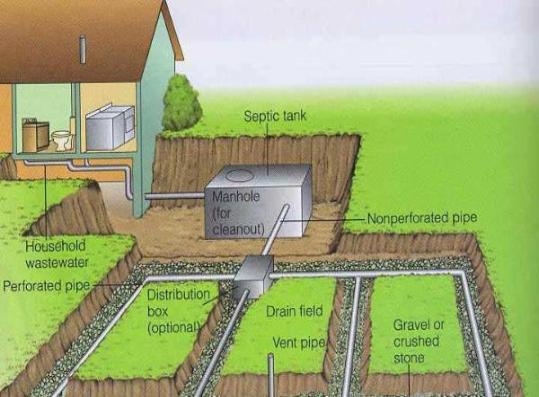
For more information about septic systems and how they work, please see this web site from the EPA - a homeowners guide to on-site septic systems:
Waste and Vent Pipe Materials: ABS plastic
ONSITE SEPTIC SYSTEM
Based on visible components, this property appears to have a private on-site septic system. These are specialty systems and are excluded from this inspection. Comments in this report related to this system are made as a courtesy only and are not meant to be a substitute for a full evaluation by a qualified specialist. Generally, septic tanks should be pumped and inspected every 3 years. Depending on the type of system and municipal regulations, inspection and maintenance may be required more frequently, often annually. I recommend:
- Investigating any information about this system's maintenance and repair history
- Reviewing any documentation available for this system
- Learning inspection and maintenance requirements for this system
- Hire a qualified specialist to evaluate, perform maintenance and make repairs as needed
 |  |  |
 |
Exterior Hose Bibs
Operating, Hot and Cold (Be Sure to Winterize)
Water Pressure: Water Pressure Tested, 60 PSI
This shows the water pressure tested during the inspection. Generally, "normal water pressure" should be between 30-80 PSI, though pressures near or below 30 can result in poor functional flow to fixtures. Water pressures in excess of 80 PSI risk damaging supply piping components and should be controlled with a pressure-reducing valve.
 |  |
BE SURE TO WINTERIZE HOSE BIBS PRIOR TO FREEZING WEATHER
These hot and cold hose bibs should be winterized during cold weather to prevent freezing.

Sump Pumps and Drains
Floor Drain: None noted
Sump Pumps: None noted
Sewage Ejector Pumps
Sewage Ejector Pump: None noted
WATER HEATERS
House Water Heater
System Type: Heat Pump / electric hybrid
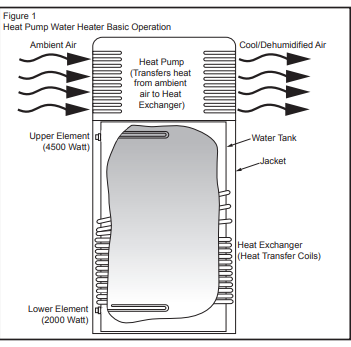
This building has a heat pump water heater installed. These are water heater storage tanks that can use elements to heat the water as is done in a conventional electric water heater or they can use a refrigerant cycle when in heat pump mode. You should notice several modes of operation for this system:
- Hybrid Mode - combines high efficiency with reduced recovery times
- Efficiency Mode - the most energy efficient mode uses the heat pump the most but has reduced recovery time
- Electric Mode - by-passes the heat pump and functions as a regular electric water heater
- Vacation Mode - - reduces temperature while away for energy savings
Heat pump water heater can be more energy efficient than a conventional water heater depending on how you run them. Please note that when in heat pump mode, heat will be extracted from the space in which they are installed. If that room communicates with exterior air, you may not notice, but in the water heater is installed in a basement or garage, these rooms could appear surprisingly cold. Attached, please find a Link to AO Smith, a common brand of heat pump water heater.
 |  |  |
 |
Manufacturer: Bradford-White
Data Plate: 📸
WATER HEATER DATA PLATE

Size: 80 gal
In 2015, the federal government updated minimum standards for the energy efficiency of water heaters. This can impact replacing water heaters that are greater than 55 gallons. This article will help you understand how this could impact your next water heater purchase. https://getscribeware.com/blog/federal-government-changed-next-water-heater/
Age: New
Energy Source: Electricity
Straps : Present
Pad: None Needed
Drain Pan: Not Needed
Expansion Tank: Present
Relief Valve: Present - Not Tested
A temperature and pressure relief valve (TPRV) is required on all water heaters to discharge any excessive pressure within the tank. A discharge pipe should be attached to the valve and directed to a safe location away from body contact. Newer installations must be directed to the building exterior or to an approved indoor drain receptor. Most manufacturers suggest that homeowners test these valves at least once a year by lifting the lever to ensure the valve discharges properly and also recommend inspection of these safety devices every three years. The picture here shows a typical TPRV. They may also be found on the side of the heater on some models. I do not test these valves due to the possibility that they may leak after testing. A leaking or inoperative TPRV should be replaced immediately by a licensed plumber.
Due to inconsistencies between both UPC and IPC Plumbing codes, and water heater manufacturer's instructions, and TPRV manufacturer instructions, it is not actually possible to install the drain from the Water Heater TPRV "properly." There are conflicts with distance of termination to the floor/ground, types of pipes approved, and diameters of pipes approved. Additional confusion is added when jurisdictional inspectors approve installations/materials specifically not allowed by both codes and manufacturers. My recommendations will vary depending on the installation and will be included in the applicable narratives below.
Most codes defer to manufacturer instructions and I favor those recommendations. The yellow tag on the valve states clearly the termination should be 6" above the floor which is more consistent with the UPC code requirements.
 (1) (1).jpg)
Bollard: None Required
Height: Ok
Water Temperature
Water Temperature Measured During Inspection: Testing Note, 120 Degrees F
The water temperature was tested multiple times during inspection. It is common for water temperatures to fluctuate throughout the house depending on the distance from the water heater, the water heater settings, the type of water heater and any thermostatic controls used in the plumbing fixtures and mixing valves. For reporting, the median temperature is used.
This thermal image shows the approximate water temperature at the time of inspection.

ADDITIONAL PLUMBING
Irrigation
Noted For Buyer
IRRIGATION SYSTEM NOTED
An exterior irrigation system was noted for this yard. Sprinkler systems are beyond the scope of this inspection. My own experience with irrigation systems is that they require annual attention/repair/servicing after every winter.
Recommendation
Inquire with the seller for any information about winterizing this system, as this should be done before cold weather. When testing the system, be sure sprinkler heads are adjusted so the system is not watering the side of the house. Hire a specialist to evaluate this system further as desired.
 |  |
INTERIOR
Floors and Floor Materials
Floor Materials: Hardwood, Tile
Floor Settlement: None noted
Walls, Ceilings, Trim, Hallways and Closets
Wall and Ceiling Materials: Drywall
Wall Insulation and Air Bypass
Wall Insulation: Not Visible
BLOWER DOOR TEST RESULTS
Blower Door Test Results Were Noted: Apparently, the building tested at 4.89 air changes/hour or ACH. The building or dwelling unit shall be tested and verified as having an air leakage rate of not exceeding 4 air changes per hour (WA State Amendment to the Energy Code as of 2024). Testing shall be conducted with a blower door at a pressure of 0.2 inches w.g. (50 Pascals).

Interior Stairs and Railings
Standard
Interior Doors
Interior Doors: Solid Core
DOOR REPAIRS NEEDED
A number of repairs are needed for the doors in this building. Examples of observations noted during the inspection include:
- The door to the northeast bedroom on the main floor is not latching
- The backs of a number of the second floor bifold doors have not been sanded. They're very scratchy.
Recommendation
Hire a qualified general contractor to further evaluate and repair/adjust interior doors for reliable performance.


Windows
Window Glazing: Double pane
Interior Window Frame: Vinyl
Window Styles: Casement, Fixed pane
KITCHEN
General Kitchen Photos
 |  |
Sinks and Faucets
Kitchen Sinks: Tested
Cabinets and Countertops
Countertop Material: Slab Surface
Cabinet Material: Wood laminate, Wood
Disposers
Disposer: None noted
Dishwasher
Dishwasher: Present
Dishwasher Air Gaps and Johnson Tees: Air Gap Present
Water Hammer Arrestor : None Noted
NO WATER HAMMER ARRESTOR WAS FOUND - DISHWASHER
Water hammer arrestors are required where quick closing valves are utilized - this is most dishwashers and washing machines. Installation of a hammer arrestor device is recommended for improved reliability of the piping system.

Ventilation Method
Fan Above Cooktop
Ranges, Ovens and Cooktops
Range/ Oven /Cook-tops: Electric, Induction Cooktop, New Construction (Burn Off Recommended)
This kitchen has an induction cooktop. These are unique cooking systems and are very energy efficient. Induction cooking uses induction heating to directly heat a cooking vessel, as opposed to using heat transfer from electrical coils or burning gas as with a traditional cooking stove. For nearly all models of induction cooktop, a cooking vessel must be made of a ferromagnetic metal, or placed on an interface disk which enables non-induction cookware to be used on induction cooking surfaces.
In an induction cooker, a coil of copper wire is placed underneath the cooking pot. An alternating electric current flows through the coil, which produces an oscillating magnetic field. This field induces an electric current in the pot. Current flowing in the metal pot produces resistive heating which heats the food. While the current is large, it is produced by a low voltage.
An induction cooker is faster and more energy-efficient than a traditional electric cooking surface. It allows instant control of cooking energy similar to gas burners. Other cooking methods use flames or red-hot heating elements; induction heating heats only the pot. Because the surface of the cook top is heated only by contact with the vessel, the possibility of burn injury is significantly less than with other methods. The induction effect does not directly heat the air around the vessel, resulting in further energy efficiencies. Cooling air is blown through the electronics but emerges only a little warmer than ambient temperature.
The magnetic properties of a steel vessel concentrate the induced current in a thin layer near its surface, which makes the heating effect stronger. In non-magnetic materials like aluminum, the magnetic field penetrates too far, and the induced current encounters little resistance in the metal.[1] At least one high-frequency "all metal" cooker is available, that works with lower efficiency on non-magnetic metal cookware.
 |  |
BURN OFF THE OVEN
Burning off the new oven is recommended to eliminate smoking and odor during operation. New ovens will always produce acrid smoke during the first use. Running for several hours prior to use and ventilating the space and help get this new appliance ready for daily use.
The oven was tested during the inspection and were operable. Ovens are tested in bake mode only. Appliances are generally beyond the scope of a home inspection but are tested for basic function as a courtesy. This does not include testing to see if the thermostat is accurate, for example.

Refrigerators
Refrigerator: Operating with IR
THE BEVERAGE REFRIGERATOR TEMPERATURE WAS NOT SET
Have this set and made operable as needed.

Thermal images show the freezer and refrigerator working during the inspection.

 |  |  |
 |  |

Kitchen Electrical
Kitchen Electrical : Lights and Receptacles Tested
General Kitchen Condition
Standard
LAUNDRY
Laundry Photos

Washer
Tested
During inspection, I try and run the clothes washing machine. This is mostly so that I can push water down the drain to test the waste piping system. Running the clothes washer during an inspection is not a reliable test of the appliance. I am not actually doing a load of laundry, so please note the limitations of this test.
MOISTURE ALARM RECOMMENDED
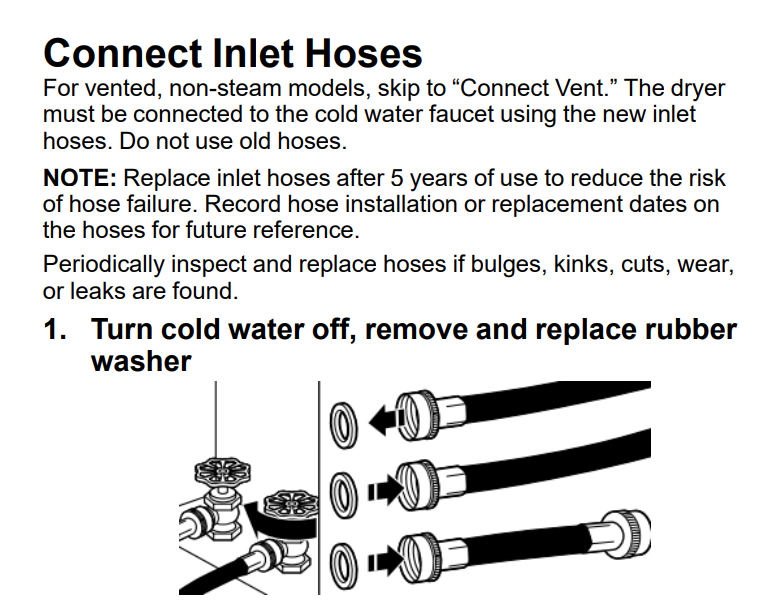
A moisture alarm with water shut-off features is recommended under the washing machine to protect against accidental leaks in the supply hoses. Pans can be effective when there is a drain, but even these will not protect against a burst supply connector. A moisture alarm with automatic shut-off will. Watts is a brand I have seen installed: Link. Please also note that appliance manufacturers recommend replacing supply hoses every 5 years to reduce the risk of failure.
 | .png) |
ROUGHED IN LAUNDRY FACILITIES
It looks as though a 2nd laundry facility has been roughed in for this building. Inquire with the seller regarding any additional information.

Dryer
Tested
Proper dryer exhaust venting is critical for safe and reliable performance from the dryer. Here are some basic rules of thumb for dryer exhaust duct installation: Unless a vent-free appliance is being used, the dryer exhaust vent must terminate outdoors. It should be no more than 25 feet long and for every 90 degree turn subtract 5 feet and for every 45 degree bend subtract 2.5 feet. Use only smooth-wall metal vent pipe @ 4 inch pipe diameter. Do not use plastic pipe and plastic flex pipe. If a flexible connector is needed behind the dryer use a short amount of corrugated metal pipe. If the exhaust duct is getting pinched behind dryer, consider use of a dryer vent box, pictured here. Flex and corrugated pipes should never be used in concealed spaces such as through walls or in attic or crawl spaces. Insulate dryer exhaust duct where it passes through unconditioned spaces to prevent condensation that could hasten lint build-up inside the pipe. Do not use screws to connect pipe as these can trap lint. Secure duct with foil tape as needed. Be sure duct is sleeved properly so that it will not trap lint and clean the vent regularly, especially if it is a long exhaust run.
.png)
Thermal image shows the dryer was tested and operating at the time of inspection.

Laundry Sinks
None noted
Laundry Ventilation
Type: Fan and window
GUEST BATHROOM
General Bathroom Photos
 |  |
Sinks and Cabinets
Tested
CABINET ADJUSTMENT
The cabinet door is hitting the base trim in the guest bathroom - adjust as needed.

Toilet
Toilet mounted on concrete/stone tile surface - the moisture meter is not effective
Bathtub / Shower
Tested
Shower Type: Tile
TILE SHOWER NOTED
Please note that the longevity and reliability of the tile depend on what it is mounted on and what it is mounted with. This critical tile preparation is not visible to inspection. We make our best guesses about tile reliability using visual inspection and sounding for loose tiles. Moisture meters can also be used in some wall applications, but the moisture meter presents a false positive on most tile floors or pans. Regular tile cleaning and sealing can help prolong the life of a tile shower installation. Temporary repairs to tile can sometimes be made depending on how the tile was prepared and the owner's desire for a cosmetic appearance.
Bathroom Ventilation
Type: Bath fan
Bathroom Electric
Bathroom Lights and Receptacles : Tested
GFCI Protection: Present and Tested
General Bath
Standard
UPSTAIRS BATHROOM
General Bathroom Photos
 |  |
Sinks and Cabinets
Tested
Toilet
Toilet mounted on concrete/stone tile surface - the moisture meter is not effective
Bathtub / Shower
Tested
Shower Type: Tile
TILE SHOWER NOTED
Please note that the longevity and reliability of the tile depend on what it is mounted on and what it is mounted with. This critical tile preparation is not visible to inspection. We make our best guesses about tile reliability using visual inspection and sounding for loose tiles. Moisture meters can also be used in some wall applications, but the moisture meter presents a false positive on most tile floors or pans. Regular tile cleaning and sealing can help prolong the life of a tile shower installation. Temporary repairs to tile can sometimes be made depending on how the tile was prepared and the owner's desire for a cosmetic appearance.
Tub Type: Acrylic/Fiberglass
Bathroom Ventilation
Type: Bath fan
Bathroom Electric
Bathroom Lights and Receptacles : Tested
GFCI Protection: Present and Tested
General Bath
Standard
PRIMARY BATHROOM
General Bathroom Photos

Sinks and Cabinets
Tested
Toilet
Toilet mounted on concrete/stone tile surface - the moisture meter is not effective
Bathtub / Shower
Tested
Shower Type: Tile
TILE SHOWER NOTED
Please note that the longevity and reliability of the tile depend on what it is mounted on and what it is mounted with. This critical tile preparation is not visible to inspection. We make our best guesses about tile reliability using visual inspection and sounding for loose tiles. Moisture meters can also be used in some wall applications, but the moisture meter presents a false positive on most tile floors or pans. Regular tile cleaning and sealing can help prolong the life of a tile shower installation. Temporary repairs to tile can sometimes be made depending on how the tile was prepared and the owner's desire for a cosmetic appearance.
Bathroom Ventilation
Type: Bath fan
Bathroom Electric
Bathroom Lights and Receptacles : Tested
General Bath
Standard
HALL BATHROOM
General Bathroom Photos

Sinks and Cabinets
Tested
Toilet
Toilet mounted on concrete/stone tile surface - the moisture meter is not effective
Bathtub / Shower
Tested
Shower Type: Tile
TILE SHOWER NOTED
Please note that the longevity and reliability of the tile depend on what it is mounted on and what it is mounted with. This critical tile preparation is not visible to inspection. We make our best guesses about tile reliability using visual inspection and sounding for loose tiles. Moisture meters can also be used in some wall applications, but the moisture meter presents a false positive on most tile floors or pans. Regular tile cleaning and sealing can help prolong the life of a tile shower installation. Temporary repairs to tile can sometimes be made depending on how the tile was prepared and the owner's desire for a cosmetic appearance.
INADEQUATE HOT WATER TEMPERATURES IN SHOWERS
I did not get adequate hot water when testing the bathroom showers on the main floor. Building standards do not consider water hot until at least 100 degrees F. I generally expect that fixtures, when tested in full hot, should provide hot water to roughly 120 degrees F, though this can vary by the fixture's proximity to the water heater. Hot water at any given fixture should never exceed 120 degrees F. I recommend additional inspection of these shower fixtures by a qualified plumbing contractor. Repair could necessitate adjustment of the water heater or downstream mixing valves or possibly even eliminating redundant mixing valves.
 |  |
Upper showers tested close to 100 degrees. F
 |  |
Bathroom Ventilation
Type: Bath fan
Bathroom Electric
Bathroom Lights and Receptacles : Tested
GFCI Protection: Present and Tested
General Bath
Standard
ATTIC
Attic Access
Crawled partial
VAULTED CEILING WITH A LOFT CONFIGURATION
Note that this building has vaulted ceilings. There is a loft space, but this is not an attic as it is inside the thermal envelope. Inspection of the framing, thermal barriers, and ventilation system was limited.

 |
Attic Pulldown Ladders
None Noted
Roof Framing and Sheathing
Rafters: 2x10
Sheathing: Skip sheathing, OSB
This shows the small attic knee wall area - east side.
 |  |  |
 |
Fire Separation and Fire Blocking
Fire Blocking and Fire Separation in Attic: Not Visible
Attic Insulation
Insulation Type: Fiberglass
Approximate Insulation R-Value on Attic Floor: 49, Not visible - vaulted ceiling
Attic and Roof Cavity Ventilation
Attic Ventilation Method: Soffit vents, Ridge vents
Attic and roof cavity ventilation is a frequently misunderstood element of residential construction. All roof cavities are required to have ventilation. The general default standard is 1 to 150 of the attic area and ideally, this comes from at least 60% lower roof cavity ventilation and 40% upper, but this is an over-simplifications of the subject. As a good guiding principle the most important elements for healthy attic spaces, which are traditionally insulated and ventilated are:
- Make sure the ceiling between the living space and the attic is airtight
- Ventilate consistently across the whole lower part of the roof cavity with low, intake soffit venting
- Upper roof cavity venting is less important and if over-installed can exacerbate air migration into the attic from the living space.
- Avoid power ventilators which can depressurize the attic and exacerbate air migration from the house into the attic.
For more information, please see: Link
CRAWL SPACE
General Crawl Space
Method of Inspection: Crawled
During inspection of the crawl space, every effort is made to inspect the entire space. Visual inspection of crawl spaces is difficult and limited as access is often restricted by pipes, ducts and sub-floor insulation as well as limited clearances.
The photos provided here show representative images of this crawl space at the time of inspection.
 |  |  |
 |  |  |
Crawl Space Access
Crawl Space Access Locations: Interior access hatch
Vapor Barrier
Vapor Barrier Material: Plastic on earth
OLD VAPOR BARRIER
The vapor barrier here is old and covered in saw dust and debris. It seems to be mostly intact but was not updated during recent renovation work.
 |  |
Crawl Space Ventilation
Ventilation Method: Exterior wall vents
Posts and Footings
Standard
Insulation
Insulation Type: Fiberglass
Approximate R-Value: R-30
CRAWL SPACE INSULATION REPAIR
The subfloor insulation in the crawl space requires tune-up repair. Secure all loose and sagging insulation.
Recommendation
Replace insulation where missing. Ensure the entire subfloor is insulated.
✒️
- When making repairs, check all penetrations through the floor; it is best to seal any noticeable air leaks between the crawl space and the living space.

Moisture Conditions
No water was visible or present at the time of inspection
STRUCTURE AND BASEMENT
Foundation
% of Foundation Not Visible: 30%
Evidence of Seismic Protection: Inquire with Seller if Done During Renovation Work?
Building Configuration: Crawl space, Slab on grade (garage slab)
Foundation Description: Poured concrete
HAS SEISMIC RETROFFITING WORK BEEN DONE
Inquire with the builder if any seismic retrofitting work was done during renovations to the building.
TYPICAL FOUNDATION CRACKS NOTED
Small cracks were noted in the foundation. The purpose of the foundation is to connect the weight of the building to well-compacted soils below the house so that the house does not move or settle. Concrete cracking can indicate poorly compacted soils below the house which could require repair, but small cracks such as these can also be a sign of routine concrete shrinkage. It is not possible to determine or verify the cause of these cracks during a visual inspection. The easiest way to prevent ongoing settlement in buildings is by controlling roof runoff and site drainage to promote dry soils around the foundation; wet soils do not bear weight well. This will also help to prevent crawl space moisture problems. In my experience, small cracks like these are common in concrete foundations of this age.
✒️
- No repair seems needed at this time. These look like typical cracks in foundations of this age.
- Monitor these cracks. If continued movement is noted, seek additional opinions from a structural engineer or qualified contractor to determine an accurate scope and urgency for repair.
- Crack monitors can be purchased to help monito foundation cracks.
 |  |
Floor, Wall and Ceiling Framing
Wall Framing: Not visible
Wall Sheathing: Not visible
Floor Framing: Partly visible, 2x10
Sub-Floor Material: Not visible
Ceiling Framing: Not visible
WOOD PONY WALL BELOW GRADE AND FAILING METAL FLASHING
There is an unusual configuration with a wood wall installed between the crawl space and the garage slab. This wall looks to be below grade and the metal material that is between the soils and the wood is corroded and failing. The wood wall does not seem damaged at this time, but the metal is no longer reliable and could be difficult to replace.
Recommendation
I recommend additional inspection of this configuration by a qualified contractor. Implement repairs as recommended. Please note that additional inspection is needed to determine an accurate scope and urgency for repair.
 |  |  |
 |
Basement
None
RODENTS, PESTS, AND WOOD DESTROYING ORGANISMS
Rodents
Some signs
RODENT TRAPS NOTED
Rodent traps were found in the crawl space. No feces were noted during the inspection. Inquire with the seller regarding any history of rodent problems. Please note that ongoing baiting and trapping is always recommended as rodent control is a constant part of home ownership.

Other Pests
None noted
Wood Destroying Organisms
Visible Evidence of Active Wood Destroying Insects: None noted
Visible Evidence of Inactive Wood Destroying Insects: None noted
Visible Evidence of Damage from Wood Destroying Insects: None noted
Visible Evidence of Active Wood Decay and Fungi: None noted
Visible Evidence of Conditions Conducive to Wood Destroying Organisms: Present, See WDO observations in this report
REMOVE CELLULOSE AND CONSTRUCTION DEBRIS FROM THE CRAWL SPACE
Wood and cellulose debris were noted in the crawl space. This can encourage wood-destroying organisms such as subterranean termites. Removal of all cellulose debris from the crawl space is recommended to eliminate conditions conducive to wood-destroying organisms. This should include the removal of all construction materials and wood debris.
 |  |  |
 |
Signed Contracts
Orca Inspection Services LLC
206-713-5715
www.orcainspect.com
orcainspect@gmail.com
.gif)
.gif)
.jpg)