
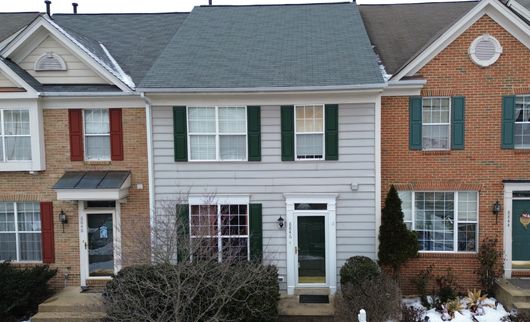
Heriberto Interiano, MD, D.C & VA State License #MD 34937, VA 3380002208
The Scope and Purpose of a Home Inspection
Purchasing property involves risk
The purpose of a home inspection is to help reduce the risk associated with the purchase of a structure by providing a professional opinion about the overall condition of the structure. A home inspection is a limited visual inspection, and it cannot eliminate this risk. Some homes present more risks than others. We cannot control this, but we try to help educate you about what we don’t know during the inspection process. This is more difficult to convey in a report and one of many reasons why we recommend you attend the inspection.
A home inspection is not an insurance policy.
This report does not substitute for or serve as a warranty or guarantee. Home warranties can be purchased separately from insuring firms that provide this service.
A home inspection is visual and not destructive.
The descriptions and observations in this report are based on a visual inspection of the structure. We inspect the aspects of the structure that can be viewed without dismantling, damaging, or disfiguring the structure and without moving furniture and interior furnishings. Areas that are concealed, hidden, or inaccessible to view are not covered by this inspection. Some systems cannot be tested during this inspection as testing risks damaging the building. For example, overflow drains on bathtubs are generally not tested because if they were found to be leaking, they could damage the finishes below. Our procedures involve non-invasive investigation and non-destructive testing, which will limit the scope of the inspection.
This is not an inspection for code compliance.
This inspection and report are not intended for city / local code compliance. During the construction, process structures are inspected for code compliance by municipal inspectors. Framing is open at this time, and conditions can be fully viewed. Framing is not open during inspections of finished homes, limiting the inspection. All houses fall out of code compliance shortly after they are built, as the codes continually change. National codes are augmented at least every three years for all disciplines. Municipalities can adopt and phase in sections of the codes on their timetables. There are generally no requirements to bring older homes into compliance unless substantial renovation is being done.
This is just our opinion.
Construction techniques and standards vary. There is no one way to build a house or install a system in a house. The observations in this report are the opinions of the home inspector. Other inspectors and contractors are likely to have some differing opinions. You are welcome to seek opinions from other professionals.
The scope of this inspection
This inspection will include the following systems: exterior, roof, structure, drainage, foundation, attic, interior, plumbing, electrical, and heating. The evaluation will be based on limited observations that are primarily visual and non-invasive. This inspection and report are not intended to be technically exhaustive.
Your expectations
The overall goal of a home inspection is to help ensure that your expectations are appropriate for the house you are proposing to buy. To this end, we assist with the discovery by showing and documenting observations during the home inspection. This should not be mistaken for a technically exhaustive inspection designed to uncover every defect in a building. Such inspections are available, but they are generally cost-prohibitive to most homebuyers.
Your participation is requested.
Your presence is requested during this inspection. A written report will not substitute for all the possible information that can be conveyed verbally by a shared visual observation of the conditions of the property.
How to Read This Report
Getting the Information to You
This report is designed to deliver important and technical information in a way that is easy for anyone to access and understand. If you are in a hurry, you can take a quick look at our "Summary Page” and quickly get the critical information for important decision-making. However, we strongly recommend that you take the time to read the full Report, which includes digital photographs, captions, diagrams, descriptions, videos, and hot links to additional information.
The best way to get the layers of information presented in this report is to read your report online, which will allow you to expand your learning about your house. You will notice some words or series of words highlighted in blue and underlined – clicking on these will provide you with additional information.
This report can also be printed to a PDF file and printed on paper as desired.
Chapters and Sections
This report is divided into chapters that parcel the home into logical inspection components. Each chapter is broken into sections that relate to a specific system or component of the home. You can navigate between chapters with the click of a button on the left-side margin.
Most sections will contain some descriptive information in black font. Observation narrative, done in colored boxes, will be included if a system or component is found to be significantly deficient in some way or if we wish to provide helpful additional information about the system or the scope of our inspection. If a system or component of the home was deemed to be in satisfactory or serviceable condition, there might be no narrative observation comments in that section, and it may simply say “tested” or “inspected.”
Observation Labels
All narrative observations are colored, numbered, and labeled to help you find, refer to, and understand the severity of the observation. Observation colors and labels used in this report are:
- Major Concern:Repair items that may cost significant money to correct now or in the near future, or items that require immediate attention to prevent additional damage or eliminate safety hazards.
- Repair:Repair and maintenance items noted during inspection. Please note that some repair items can be expensive to correct such as re-finishing hardwood floors, but are considered simply repair items due to their cosmetic nature.
- Recommended Maintenance:These are repair items that should be considered "routine home ownership items," such as servicing the furnace, cleaning the gutters or changing the air filters in the furnace.
- Due Diligence:Observation such as a buried oil tank that may require further investigation to determine the severity and / or urgency of repair.
- Monitor:Items that should be watched to see if correction may be needed in the future.
- Inspection Notes:Aside information and /or comments elaborating on descriptions of systems in the home that the inspector might find useful to purchase decisions or home ownership. .
- Limitations:Conditions present at the time of inspection which limited the scope of this visual inspection
Summary Page
The Summary Page is designed as a bulleted overview of all the observations noted during the inspection. This helpful overview is not a substitute for reading the entire inspection report. The entire report must be read to get a complete understanding of this inspection report, as the Summary Page does not include photographs or photo captions.
Moisture Meter Testing
Where moisture meter testing is indicated in this report, a Extech MO260 Moisture Meter was used.
Summary
Major Concerns
No major concerns were noted during this visual inspection.Repairs
- G1-3 Grounds - Driveways/Walkways/Flatwork:
TRIP HAZARD IN WALKWAY
The front walkway flatwork has settled creating a trip hazard. Hire a qualified general contractor to repair to eliminate trip hazard and ensure a reliable walking surface.
- G1-4 Grounds - Fences:
FENCE HAS BEEN CHAINED WITH LOCK
The rear fence gate has been closed with a chain and lock. Request key from sellers and test as needed.
- E-2 Exterior - Siding and Trim:
EXTERIOR ROT REPAIRS NEEDED
Localized rot repairs are needed to the exterior trim.
Recommendation
Hire a licensed general contractor to further evaluate and repair the exterior siding system. Repair and replace all damaged and decaying exterior wood as needed.
- Please note that this condition can indicate additional concealed damage/areas that is not visible to inspection.
- E-3 Exterior - Siding and Trim:
SIDING MAINTENANCE NEEDED
Localized caulking repairs are needed to the exterior of the building. This is common recommended maintenance between complete exterior paint jobs to ensure that the more exposed areas continue to preform reliably.
Recommendation
Implement painting and/or caulking repairs as recommended by a qualified contractor.
- RCG-1 Roof, Chimney and Gutters - Roof Materials:
MISALIGNED SHINGLES/ KICKOUT FLASHING MISSING
The lower right corner of the roof shows misaligned shingles, which could lead to water runoff issues and increase the risk of water intrusion. Additionally, kickout flashing is needed to direct water into the gutter and prevent damage to the siding/fascia. A professional roofing contractor should assess and address these issues to ensure proper function and durability.
- FSD-2 Fuel Storage and Distribution - Gas, Propane and Oil Piping:
IMPROPER USE OF FLEXIBLE GAS CONNECTORS
Flexible gas connectors should not run through the walls of appliances. Use rigid steel pipe only. Have this further evaluated and repaired by a qualified plumber or gas appliance technician.
- EDF-1 Electric Distribution and Finish - Receptacles and Fixtures:
INOPERATIVE LIGHTS
Inoperative lights were found in the basement. Have all inoperative lights further investigated an repaired as needed. If a new bulb does not correct the problem, consult with a licensed electrical contractor.
- EDF-2 Electric Distribution and Finish - Receptacles and Fixtures:
GFCI PROTECTED DEVICE DID NOT TRIP
The GFCI protected receptacle in the kitchen did not respond to testing and may be defective - it did not trip when tested. Have this receptacle repaired or replaced as needed.
- HCFV-3 Heating, Cooling, Fireplaces and Ventilation - Gas Fireplaces:
GAS LOG FIREPLACE SHUT OFF AND IN NEED OF SERVICE
The gas log fireplace was shut off at the time of inspection. I do not like to light these when they are shut off as I do not know why they were shut off and there could be a safety reason. Also, glass pane is foggy. I recommend having this gas log fireplace clean and serviced by a qualified contractor and made operable as needed.
- I-2 Interior - Interior Doors:
DOORS NOT LATCHING
The closet doors to the entrance foyer closet are not latching correctly and requires adjustment so the door latches closed.
- I-3 Interior - Windows:
WINDOW REPAIRS/REPLACEMENT NEEDED
All of the windows in this building are original windows that require maintenance and/or replacement. You need to decide how you want to approach the windows in this building, as they are generally older and do not comply with modern standards for energy efficiency.. Existing windows that have character are often worth preserving and restoring, whereas windows that are in worse condition and have less character may be good candidates for replacement. The windows are in poor condition for age and type.
Examples of observations noted during the inspection include:
- Some windows in the home are not operating and may be painted/sealed shut.
- Missing window hardware was noted
- Condensation noted
- Many of the windows are single pane glass - these older windows do not comply with modern energy efficiency standards
- I-4 Interior - Windows:
LOST SEAL / FAILED INSULATED GLASS UNIT
The exterior front right side window were presenting with a cloudy appearance. Often referred to as a, "lost seal," the cloudy appearance cannot be cleaned. Affected glass typically requires glazing repair or replacement.
Recommendation
Hire a glass replacement company to further evaluate the windows and glass here and replace/update all insulated glass units with lost seals.
✒️
- This is a common occurrence in insulated glass, especially as they age and on sun-exposed sides of the building.
- K-3 Kitchen - Cabinets and Countertops:
CABINET DRAWER IN CONFLICT
A kitchen cabinet drawer adjustment is needed for proper operation of the kitchen cabinet as is in conflict with the dishwasher.
- LF-1 Laundry Facilities - Dryer:
SCREENED DRYER EXHAUST VENT COVER
The dryer exhaust duct termination at the exterior of the building is covered with a screen. This is a potential safety hazard that could block lint and cause a fire. Replace this vent cover with a cover that has a backdraft damper.
- B-2 Bathrooms - Sinks and Cabinets:
SLOW SINK DRAIN
A slow drain was noted at the basement bath sink. Repair as needed so the drain keeps up with the fixture supply.
- This often involves just cleaning out the trap.
- B-3 Bathrooms - Bathtub / Shower:
SLOW TUB DRAIN
The main bath bathtub drain is slow and appears to be obstructed. Repair as needed for reliable drainage.
- A-2 Attic - Attic Insulation:
BAFFLES NOT INSTALLED
Cardboard baffles have not been installed in the rafters near the eaves in the attic. This has allowed the fiberglass batt insulation to block ventilation from the soffit. This can inhibit proper ventilation of this roof cavity and can lead to heat build-up and seasonal moisture problems. It is recommend removing insulation away from the roof decking in these areas as is possible - this will be difficult work due to the tight space restrictions. Where possible baffles should be added though this could be difficult at this point.
- A-3 Attic - Attic Insulation:
ATTIC INSULATION ADJUSTEMENT RECOMMENDED
Localized tune-up repairs are needed to the attic insulation to ensure reliable performance. During inspection the following observations were noted:
✒️
- Blown in insulation has been disturbed by contractors or prior attic access
Recommended Maintenance
- G1-2 Grounds - Drainage and Site:
DOWNSPOUTS DISCHARGE NEAR FOUNDATION
Downspouts are discharging adjacent to the foundation. This can cause foundation settlement or basement moisture problems. Make sure all downspouts discharge into a proper tight-line system that diverts water at least 5 feet away from the foundation.
- HCFV-2 Heating, Cooling, Fireplaces and Ventilation - Heating Systems:
SERVICE THE HEATING SYSTEM
Annual servicing of gas forced air furnaces is recommended for safe and reliable heat. I could not find recent service records on the furnace. A servicing is recommended if one has not been done in the last year. The furnace was tested during the inspection and was operational.
Due Diligence Items
- FSD-1 Fuel Storage and Distribution - Gas, Propane and Oil Piping:
NO CSST BONDING FOUND
The 2009 edition of NFPA 54, National Fuel Gas Code, includes new requirements for special bonding for CSST gas piping systems to the grounding conductor of the building's electrical system to reduce the possibility of damage by lightning strikes by reducing the electrical potential between metallic objects and building systems, including gas distribution. I was unable to locate a bonding connection for the CSST during the inspection today. Have this further evaluated and repaired as recommended by a qualified CSST installer.
✒️
- It is possible that bonding is present and was simply not found
- This building pre-dates requirements for bonding so it is more likely the gas piping was never bonded.
- P-1 Plumbing - Water Meter:
NO WATER METER FOUND
No water meter was found. This house seems to be on a public water system, which should have a metering device. Inquire with the seller or the utility as needed to locate the water meter.
- P-2 Plumbing - Waste Pipe and Discharge:
VIDEO SEWER SCOPE RECOMMENDED
An evaluation of the sewer line below the ground is beyond the scope of this inspection. A sewer scope is recommended to further evaluate the sewer line and the below ground connections between the house and the municipal sewer line as these are not visible to inspection. Sewer scopes are done using video cameras and can show the materials, condition and reliability of the sewer line. If a video scope has not been done recently, I recommend having a sewer scope performed.
- K-6 Kitchen - Refrigerators:
REFRIGERATOR FILTER NOTED
The refrigerator water / ice system seems to employ a filter. Inquire with the seller for additional information regarding replacement schedule and the types of filters needed.
Items for Monitoring
- A-1 Attic - Roof Framing and Sheathing:
OLD STAINED NOTED
A stain was observed on the FRT plywood around the chimney flue, indicating a past moisture issue. No active moisture was detected on the insulation, suggesting the issue has been resolved. It is recommended to inspect the chimney flashing and monitor the area periodically to ensure no recurrence.
📸 The Complete Report
Grounds
General Grounds Photos
Address Identification
Drainage and Site
Window and Stairwells
Driveways/Walkways/Flatwork
Grounds, Trees and Vegetation
Exterior Stairs
Retaining Walls
Fences
Outbuildings, Trellises, Storage Sheds, Barns
Exterior
Exterior Elevations
Siding and Trim
Exterior Vent and Exhaust Terminations
Eaves
Exterior Doors
Exterior Window Frames
Decks, Porches and Balconies
Wood Decks Porches and Balconies
Concrete Decks, Stoops, Landings and Porches
Water-Resistant Decks and Balconies
Roof, Chimney and Gutters
Roof Materials
Chimneys
Skylights
Gutters and Downspouts
Exterior Roofing / Framing
Electric Service
Electric Service Voltage Tested
Electric Service
Electric Service Equipment
Generator Equipment
Appliance Disconnects
Electrical Grounding System
Electrical Bonding System
Electric Distribution and Finish
Branch Wiring
Receptacles and Fixtures
Smoke and Carbon Monoxide Alarm Systems
Ceiling Fans
Heating, Cooling, Fireplaces and Ventilation
Heating and Cooling System Overview
Heating Systems
Vents and Flues
Air Filters
Heating and Cooling Distribution Systems
Heat Pumps and Cooling Systems
Mechanical Ventilation Systems
Gas Fireplaces
Solid Fuel Fireplaces
Plumbing
Water Meter
Water Service Supply
Distribution Pipe
Waste Pipe and Discharge
Exterior Hose Bibs
Additional Sinks
Sump Pumps and Drains
Sewage Ejector Pumps
Interior
General Interior Photos
Floors and Floor Materials
Walls, Ceilings, Trim, Hallways and Closets
Wall Insulation and Air Bypass
Interior Stairs and Railings
Interior Doors
Windows
Kitchen
General Kitchen Photos
Sinks and Faucets
Cabinets and Countertops
Disposers
Dishwasher
Ventilation Method
Ranges, Ovens and Cooktops
Refrigerators
General Kitchen Condition
Bathrooms
General Bathroom Photos
Sinks and Cabinets
Toilet
Bathtub / Shower
Bathroom Ventilation
General Bath
General Comments
Building Characteristics, Conditions and Limitations
Style of Home: Town home
Type of Building : Townhome
Townhouse Inspection: This inspection consists predominantly of an interior viewing of the inspected unit and a partial visual inspection of other areas of the perimeter of the structure - the roof, the grounds and the common areas that are available and open for observation. Only this unit was open to inspection, so there was no attention given to any adjacent units or other units in the structure. Regarding zero lot line townhouse construction, responsibilities for maintenance and repairs falls substantially on the individual owner, although there are sections of the structure that will need cooperative efforts for repair, such as roofs, common exterior walls, common exterior grounds etc. For specific responsibilities though, gaining information from the condominium association's agreement is recommended to determine the actual responsibilities of the new occupant and how it may be shared with the group. It is highly recommended that the association’s building records and minutes be examined to determine whether there have been issues in the past at other units that might indicate a more substantial issue than what might be observed at the inspected unit, or that might require a general assessment.
Occasionally, repairs that are planned to be undertaken at a building complex can require a substantial outlay of funds that may not be covered in the available monetary accounts of the building association. This might involve an assessment to each individual occupant. I would recommend gaining any information possible from the association regarding any planned repairs and the availability of funds to cover these situations, so as not to be surprised by a planned or special assessment.
Approximate Square Footage: 1400
The approximate square footage listed here is listed as a courtesy and is based off of public records and disclosure. An evaluation of square footage of the buildings and property lines is beyond the scope of this inspection.
Approximate Year of Original Construction: 1996
Attending the Inspection: Client's representative, Buyer
Occupancy: Occupied
Animals Present: No
Weather during the inspection: Cloudy, Ice
Please note that snow and ice will limit the scope of the inspection. Typically, a visual inspection of the roof and grounds on the outside of the house is severalty limited when snow and ice are present.
Approximate temperature during the inspection: Below 32[F]
Ground/Soil surface conditions: Snow-covered, Frozen
For the Purposes of This Report, the Front Door Faces: East
This home was occupied at the time of the inspection. Inspection of occupied homes presents some challenges as occupant belongings can obstruct visual inspection of and access to parts of the building. We do our best during inspection to work around belongings to discover as much as possible about the house without moving or damaging personal property, however, the presence of personal items does limit the inspection.
Grounds
General Grounds Photos

Address Identification
Address Identification: Address Numbers Present and Well Displayed
Drainage and Site
Clearance to Grade: Standard
Downspout Discharge: Above and below grade, Next to Foundation, Corrugated Storm Drains
Site Description: Moderate slope
DOWNSPOUTS DISCHARGE NEAR FOUNDATION
Downspouts are discharging adjacent to the foundation. This can cause foundation settlement or basement moisture problems. Make sure all downspouts discharge into a proper tight-line system that diverts water at least 5 feet away from the foundation.

Window and Stairwells
None Noted
Driveways/Walkways/Flatwork
Driveway: None noted
Walkways: Concrete
Patios: None noted
TRIP HAZARD IN WALKWAY
The front walkway flatwork has settled creating a trip hazard. Hire a qualified general contractor to repair to eliminate trip hazard and ensure a reliable walking surface.

Grounds, Trees and Vegetation
Trees/Vegetation too near building: No
Exterior Stairs
Exterior Stairs: Simple landing noted
Retaining Walls
Retaining Wall Material: None Noted
Fences
Exterior Fencing: Present
The property has a fencing system in place. Inspection and evaluation of fencing is beyond the scope of a home inspection. If the fencing system is important for your use of this property, I recommended a self-examination to see how it will meet your needs. I may make cursory comments about fencing as a courtesy.
FENCE HAS BEEN CHAINED WITH LOCK
The rear fence gate has been closed with a chain and lock. Request key from sellers and test as needed.

Outbuildings, Trellises, Storage Sheds, Barns
None noted
Exterior
Exterior Elevations
 |  |  |
 |
Siding and Trim
Trim Material: Wood
Siding Material: Aluminum
EXTERIOR ROT REPAIRS NEEDED
Localized rot repairs are needed to the exterior trim.
Recommendation
Hire a licensed general contractor to further evaluate and repair the exterior siding system. Repair and replace all damaged and decaying exterior wood as needed.
- Please note that this condition can indicate additional concealed damage/areas that is not visible to inspection.


SIDING MAINTENANCE NEEDED
Localized caulking repairs are needed to the exterior of the building. This is common recommended maintenance between complete exterior paint jobs to ensure that the more exposed areas continue to preform reliably.
Recommendation
Implement painting and/or caulking repairs as recommended by a qualified contractor.
 |  |  |
Exterior Vent and Exhaust Terminations
Exterior Siding and Vent Terminations: Present
Eaves
Aluminum
Exterior Doors
Exterior Door Styles: Solid core, Sliding glass
Exterior Window Frames
Window Frames: Wood, Vinyl
Decks, Porches and Balconies
Wood Decks Porches and Balconies
Present
To see a prescriptive guide for residential wood deck construction click this link:
Structure: Not visible
Ledger Board: Standard
Guardrail: Standard
Decking Material: Hardwood
Posts, Beams and Footings: Inspected
Overall pictures of deck
 |  |  |
Concrete Decks, Stoops, Landings and Porches
Concrete Features: Concrete entry
Water-Resistant Decks and Balconies
Water Proof Surfaces: None Noted
Roof, Chimney and Gutters
Roof Materials
Method of Roof Inspection: Viewed with a drone
Please note that the roof was too tall to access by ladder and walk safely. A drone was used to try and get some information about the roof. This is not as good an inspection as walking the roof but is the best and safest option, given limited access. Any relevant photos or videos will be included in this report.
Roof Style: Gable
Flashings, Valleys and Penetrations: Present and Visually Standard
Roof flashings are used to keep a roofing system waterproof where the roofing material starts, stops, changes direction, or is penetrated. During the inspection, we look for standard flashing techniques that could be considered normal or standard in our region. Damaged, incomplete or non-standard flashings can be a sign of an older or less reliable roofing system and may require repair. Any non-standard flashings noted during the inspection will be reported below if found.
Roof Covering Materials: Three-tab composition shingle
Approximate Age of Roof Covering: 5-10 Years
Overlay Roof: No
MISALIGNED SHINGLES/ KICKOUT FLASHING MISSING
The lower right corner of the roof shows misaligned shingles, which could lead to water runoff issues and increase the risk of water intrusion. Additionally, kickout flashing is needed to direct water into the gutter and prevent damage to the siding/fascia. A professional roofing contractor should assess and address these issues to ensure proper function and durability.
 |  |  |
Overall pictures of the roof
 |  |  |
 |  |  |
 |  |  |
Chimneys
Present
Chimney Material: Metal
Chimney Flue Liners: Not visible
Skylights
None noted
Gutters and Downspouts
Gutter and Downspout Materials: Aluminum
Exterior Roofing / Framing
None Noted
Fuel Storage and Distribution
Gas Meter
Present
Gas Shutoff Location: Side of structure
This shows the gas shut ff at the gas meter.

Gas Pipe Materials: Steel and flex pipe
Gas, Propane and Oil Piping
Gas Piping Materials Noted: CSST, Steel
IMPROPER USE OF FLEXIBLE GAS CONNECTORS
Flexible gas connectors should not run through the walls of appliances. Use rigid steel pipe only. Have this further evaluated and repaired by a qualified plumber or gas appliance technician.
 |  |  |
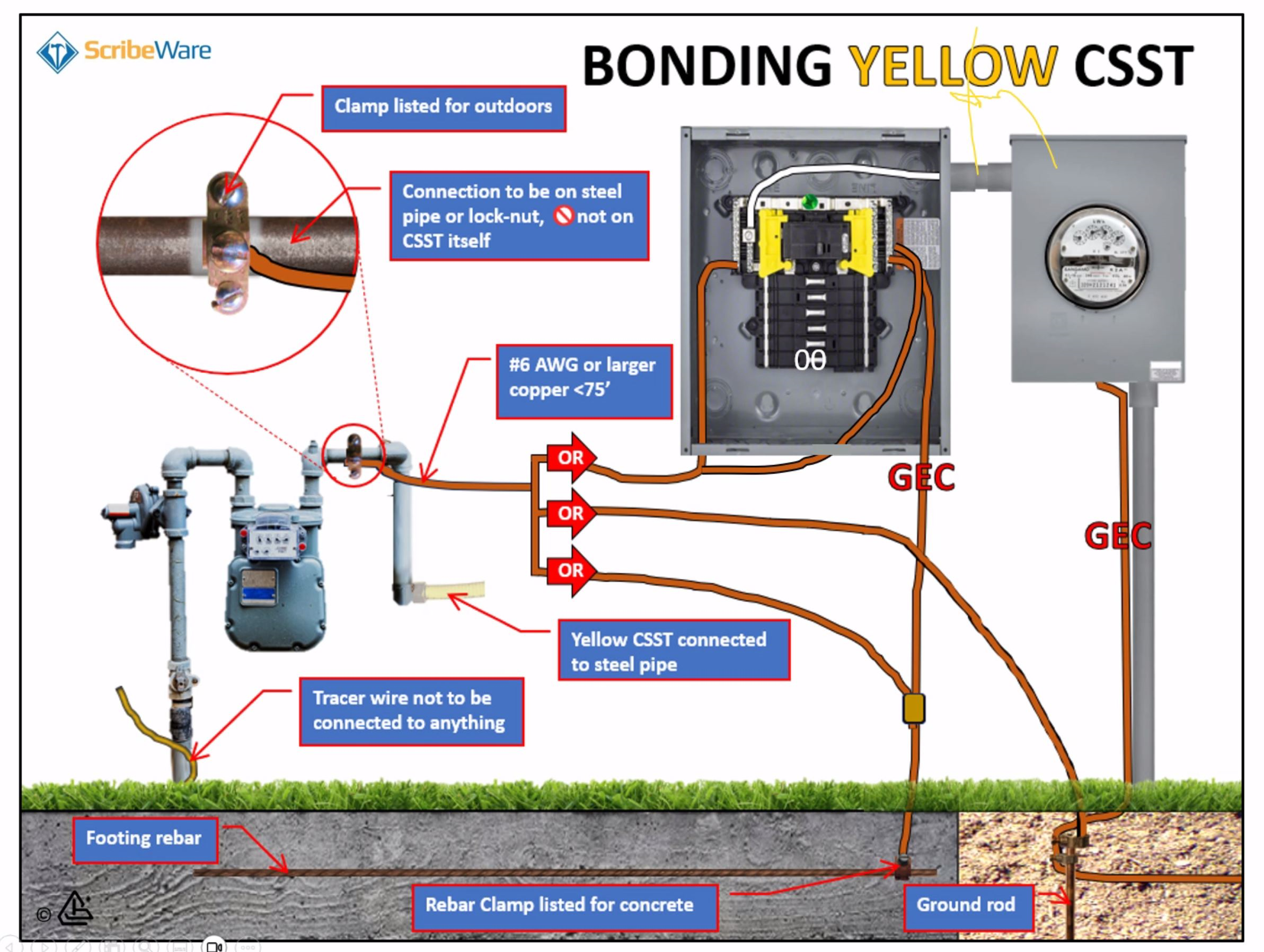
NO CSST BONDING FOUND
The 2009 edition of NFPA 54, National Fuel Gas Code, includes new requirements for special bonding for CSST gas piping systems to the grounding conductor of the building's electrical system to reduce the possibility of damage by lightning strikes by reducing the electrical potential between metallic objects and building systems, including gas distribution. I was unable to locate a bonding connection for the CSST during the inspection today. Have this further evaluated and repaired as recommended by a qualified CSST installer.
✒️
- It is possible that bonding is present and was simply not found
- This building pre-dates requirements for bonding so it is more likely the gas piping was never bonded.
Electric Service
Electric Service Voltage Tested
Service Voltage: 120/240
Electric Service
Service Entrance: Below Ground
Meter Base Amperage: 200
Electrical meter

Electric Service Equipment
Service Entrance (SE) conductor Size: Aluminum, 4/0, 200 amps
Main Panel Amperage: Listing not visible
Electric Service Amperage: 200 amps
Main Electric Panel Location: Basement
Overcurrent Protection Devices: Breakers
Panel Manufacturer: GE
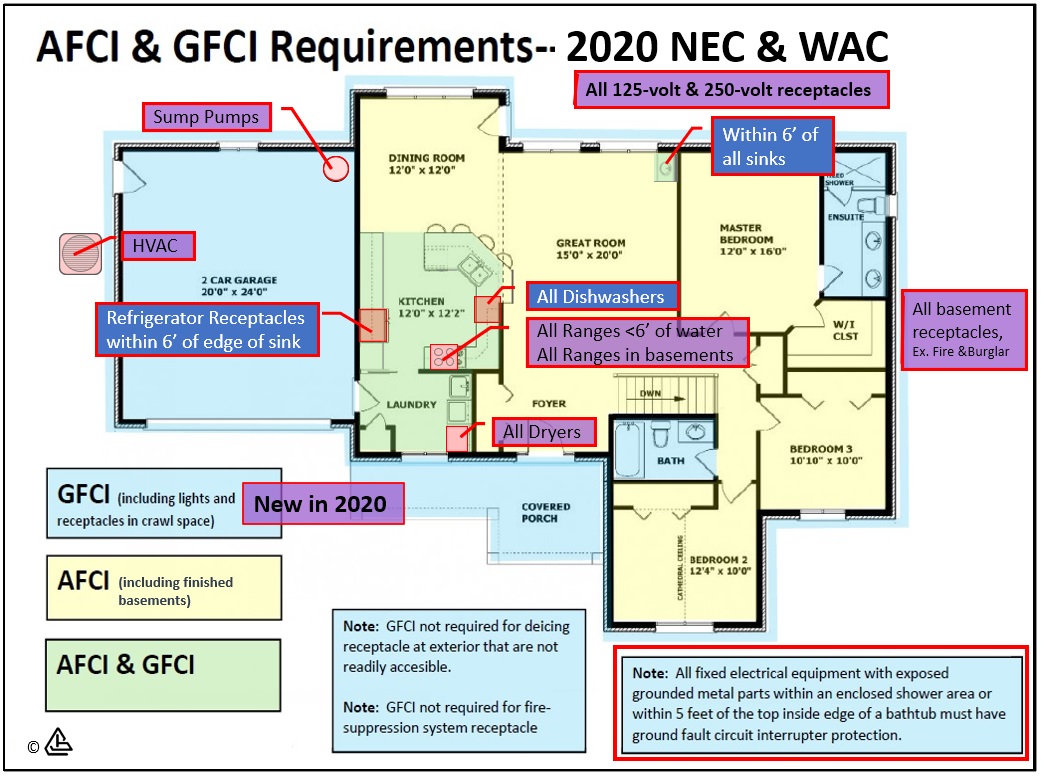
MODERN AFCI PROTECTION IS A SAFETY IMPROVEMENT
AFCI (arc fault protection) is now required on all branch circuits supplying outlets or devices installed in residential dwelling unit kitchens, family rooms, dining rooms, living rooms, parlors, libraries, dens, bedrooms, sunrooms, recreation rooms, closets, hallways, laundry areas, and similar rooms and areas. The goal of this protection is to reduce risks of electrical fires. Consult with a licensed electrician about improving circuit protection as desired. I would consider this improvement in the context of other electrical repairs or upgrades. Please note that if you add or replace receptacle outlets to the existing system, they should comply with modern AFCI standards.
.jpg) |
Circuits to look for in the panel. Most of these are dedicated except the two kitchen countertop receptacles.
KITCHEN
Refrigerator
Oven/Range
Two kitchen countertop circuits
Dishwasher
Microwave (depends)
Garbage Disposer
LAUNDRY
Washing Machine
Dryer
APPLIANCES
Water heater
AC/heat pump
Electric heaters
Hot Tub/Sauna
Overall pictures of the main electrical panel
 |  |  |
 |
Generator Equipment
None noted
Appliance Disconnects
Disconnects Noted: Air Conditioner
Electrical Grounding System
Present - Could Not Confirm
During a home or property inspection, every effort is made to inspect the visible components of the electrical system grounding. The grounding system is critical for safely discharging electrical surges, especially in the case of lightning strikes. There is no way in the context of a home inspection to verify the "effectiveness" of the grounding system as much of the system is not visible, and there are no practical tests one can perform in the way we can test a furnace or a plumbing fixture. However, many things can lead me to recommend further evaluation of the grounding system by a licensed electrical contractor, and they will be documented in the observations below if discovered.
Electrical Bonding System
Present - Could Not Confirm
During the inspection, I attempt to visually document electrical system bonding. There is no way in the context of a home inspection to verify the "effectiveness" of system bonding. All metallic systems in the building are required to be "bonded" (connected) to the the building's electrical grounding system. Bonding creates a pathway to shunt static charges (that would otherwise build up on the system) to earth, and to provide a pathway to trip a breaker in the event that these bonded metallic components became energized. There are many things that can lead me to recommend further evaluation of this system by a licensed electrical contractor and they will be documented as repair items in the observations below if discovered.
Electric Distribution and Finish
Branch Wiring
Wire Material: Copper
Wiring Method: Non-metallic sheathed cable
Receptacles and Fixtures
Inspection Method: Tested All Accessible
During inspection I make an effort to test and inspect all accessible electric receptacles and switches. In general, the scope of testing is directly related to access; where personal belonging and furniture obstruct access to receptacles and fixtures, fewer of them can be reasonably tested during inspection. All defects found during inspection today will be listed in this report. Inspection/testing of the electrical system can be challenging. It should be anticipated that not all defects will be discovered and that some issues found may actually not be defects at all. Tools used to verify proper wiring and function can vary wildly in reliability/consistency. The kinds of tools that could be used to confidently analyze the system and its function cannot typically be done in the context of a Standard Home Inspection. I look for indications of issues, based on the age of the home, types of wiring systems used etc, as well as personal experience and by testing with a variety of common tools. Issues identified, will be further discussed with recommendations in the electrical section below.
Electric Receptacles: Three wire receptacles
INOPERATIVE LIGHTS
Inoperative lights were found in the basement. Have all inoperative lights further investigated an repaired as needed. If a new bulb does not correct the problem, consult with a licensed electrical contractor.

GFCI PROTECTED DEVICE DID NOT TRIP
The GFCI protected receptacle in the kitchen did not respond to testing and may be defective - it did not trip when tested. Have this receptacle repaired or replaced as needed.

Smoke and Carbon Monoxide Alarm Systems
CO Alarms Noted: On 3rd Floor
CO Alarms: Present
The installation of carbon monoxide alarms is recommended for all homes that have fuel burning appliances such as gas or oil furnaces, gas water heaters, gas ovens and cooktops, gas fireplaces, and wood stoves. The location should be: at least one alarm outside of all sleeping areas and one on each floor of the house. Best practices are to have these alarms hardwired with a battery back-up - though requirements are for the installation to meet the manufacturer's specifications. Carbon monoxide is a colorless, odorless gas that can cause sickness, nausea, and even death. Alarms have a useful service life of roughly 6 years, so changing them more frequently than smoke alarms is recommended.
Smoke Alarms Noted:On Main FloorOn 3rd Floor
Smoke Alarms: Present
During a home inspection, a representative sample of smoke alarms is tested using the test button on the alarms. This test does not evaluate the sensor's accuracy; it simply verifies whether the unit is powered. Fire marshals recommend updating smoke alarms every ten years and changing batteries bi-annually to ensure reliability. Current data suggests using photoelectric technology in smoke alarms for enhanced fire detection and to minimize false alarms, which can lead to the disabling of this crucial safety system. Unfortunately, determining whether an alarm uses photoelectric or ionization technology requires removing the unit, and accurately testing a smoke alarm system for reliability, age, and sensor type is surprisingly complex. Many homes have half a dozen or more alarms, further complicating the assessment. A comprehensive evaluation of smoke alarms falls outside the scope of a standard home inspection.For optimal fire safety, it is recommended that homeowners take an active role in understanding, servicing, and maintaining their smoke alarm systems to ensure the safety of all building occupants. For more information, please read this link.

Carbon monoxide alarms were found and noted during inspection. Be sure to check these regularly. The standard is 1/ floor and 1 outside all sleeping areas.
Ceiling Fans
Ceiling Fans: Present and Tested
The ceiling fans were tested and operating during the inspection. I do not inspect the ceiling fan mounting as this is inaccessible to inspection. It is important the ceiling fans get well-mounted to the ceiling with proper fan fixture boxes.
 |  |  |
 |
Heating, Cooling, Fireplaces and Ventilation
Heating and Cooling System Overview
HEATING AND COOLING SYSTEM OVERVIEW


Heating Systems
Energy Source: Natural gas
Heating Method: Gas forced air furnace
This house has a gas forced air furnace. A critical component to all combustion heating equipment is the heat exchanger. This is the welded metal assembly inside the furnace that contains the products of combustion so that moisture, carbon monoxide and other products of combustion do not mix with interior air and get safely vented to the exterior. Heat exchangers on modern furnaces have an average life expectancy of 15-20 years. Unfortunately, heat exchangers are concealed inside the heating equipment; they are not visible and specifically excluded from a home inspection. Cracks in heat exchangers may be concealed and can pose a potential safety hazard.
 (1) (1) (1) (1) (1) (1) (1) (1) (1) (1).PNG)
Manufacturer: Rheem
Data Plate: 📸
This shows the data plate from the furnace.

Age: 2018
Listed Max Capacity Per Data Plate: 70,000 btu's
Last Service Record: None
SERVICE THE HEATING SYSTEM
Annual servicing of gas forced air furnaces is recommended for safe and reliable heat. I could not find recent service records on the furnace. A servicing is recommended if one has not been done in the last year. The furnace was tested during the inspection and was operational.
Vents and Flues
Present
Air Filters
Filtration Systems: Disposable
The heating and cooling system has disposable air filters installed. These should be changed quarterly or more to ensure proper airflow at the furnace. Be sure to install the filters with the arrows pointing in the same direction as the airflow in the furnace.
Filter size: 14x24x1

Heating and Cooling Distribution Systems
Heat Source in Each Room: Present
Distribution Method: Forced Air / Ducts
Thermal images show approximate temperatures at heating registers. I use these images just to show the system was generally functioning during inspection. These are representative photos.
 |  |  |
 |  |  |
 |  |
Heat Pumps and Cooling Systems
Air Conditioning Present
The following list is a minimum set of requirements to be expected of heat pump or air conditioning servicing. I provide these as a courtesy to show they types of check-ups that should be expected from a professional servicing.
- Check compressor efficiency
- Check refrigerant level
- Clean the condenser coil
- Change or clean air filters
- Inspect contactors and wiring
- Inspect drive-sheaves, pulleys and belts
- Check and adjust for proper air flow
- Clean the blower motor as needed
- Lubricate all motors and shaft bearings
- Check, calibrate and program the thermostats and be sure the thermostat has adequate batteries as needed
- Check unit smoke detector, clean filter if applicable
- Check safety disconnect, laser-temp -- check across contacts
Manufacturer: Rheem
Data Plate: 📸
This shows the data plate for the air conditioner.

System Type: Air Source
Listed Nominal Capacity: 2.5 Tons
Energy Source: Electric
Age: 2018
TOO COLD TO TEST AC
The air conditioning system and condensate control system could not be tested during inspection. Outdoor temperatures should exceed 65 degrees F for at least 24-hours or the air conditioning equipment can be damaged by testing. It is recommended having this system serviced and inspected prior to the next cooling season.

Mechanical Ventilation Systems
Bath Fan Ducting: Ductwork not visible
Determining proper ventilation to the exterior from kitchen, bath, and laundry fans can be tricky as exhaust fan ductwork is often concealed behind finishes and fan terminations can be all over the house from the roof to the foundation, presenting difficulties for systematically checking every fan termination. During inspection, every effort is made to verify proper terminations of fan vents to the exterior, but it is possible to miss something here that is latent or concealed.
Kitchen Fan Ducting: None noted
Gas Fireplaces
Fireplace Types: Fireplace insert
Battery Cradle: Not Applicable
GAS LOG FIREPLACE SHUT OFF AND IN NEED OF SERVICE
The gas log fireplace was shut off at the time of inspection. I do not like to light these when they are shut off as I do not know why they were shut off and there could be a safety reason. Also, glass pane is foggy. I recommend having this gas log fireplace clean and serviced by a qualified contractor and made operable as needed.
 |  |
Solid Fuel Fireplaces
Fireplace Types: No wood burning fireplaces or appliances noted
Plumbing
Water Meter
Not Found - Inquire With Seller
NO WATER METER FOUND
No water meter was found. This house seems to be on a public water system, which should have a metering device. Inquire with the seller or the utility as needed to locate the water meter.
Water Service Supply
Pipe Material: Plastic
Water Supply: Public water
Pressure Reducing Valve: Present
This house has a pressure-reducing valve to control the water pressure. This typically turns the piping system for the building into a closed system. Closed systems require some type of thermal expansion device, typically provided by an expansion tank at the water heater. Though other options exist, such as a Governor 80.

Main Water Shut-off Location: Basement
Main water shutoff valve located behind the clothes washer

Distribution Pipe
Pipe Insulation: Not visible
Supply Pipe Materials: Copper, Only Partly Visible
Copper water supply pipes were installed. Copper pipes installed prior to the late 1980's may be joined with solder that contains lead, which is a known health hazard especially for children. Laws were passed in 1985 prohibiting the use of lead in solder, but prior to that solder normally contained approximately 50% lead. Note that testing for toxic materials such as lead, is beyond the scope of this inspection. Consider having a qualified lab test for lead, and if necessary take steps to reduce or remove lead from the water supply. Various solutions include:
- Flush water taps or faucets. Do not drink water that has been sitting in the plumbing lines for more than 6 hours
- Install appropriate filters at points of use
- Use only cold water for cooking and drinking, as hot water dissolves lead more quickly than cold water
- Have a qualified plumber replace supply pipes and/or plumbing components as necessary
Functional Flow: Average
Circulation Pump: None Noted
SUPPLY PIPING ONLY PARTLY VISIBLE
Please note that the supply pipes are concealed behind insulation and finishes and visual inspection was limited. Determination of the supply piping materials used here is an educated guess based on the materials that were visible coming out of the wall and below fixtures.

Waste Pipe and Discharge
Discharge Type: Public Sewer - Buyer
Waste and Vent Pipe Materials: PVC
Location of Sewer Cleanout: Basement
This shows the location of the sewer cleanout found during inspection - basement.

VIDEO SEWER SCOPE RECOMMENDED
An evaluation of the sewer line below the ground is beyond the scope of this inspection. A sewer scope is recommended to further evaluate the sewer line and the below ground connections between the house and the municipal sewer line as these are not visible to inspection. Sewer scopes are done using video cameras and can show the materials, condition and reliability of the sewer line. If a video scope has not been done recently, I recommend having a sewer scope performed.
Exterior Hose Bibs
Winterized - not tested
WINTERIZED HOSE BIBS
The exterior hose bibs were winterized at the time of inspection and could not be tested. A shut off was found during inspection that is likely for the house bibs.
Additional Sinks
None noted
Sump Pumps and Drains
Floor Drain: Basement Floor Drain Present
A floor drain was noted in the adjacent to the water heater. I do not test floor drains, but I do recommend they be tested for function by the homeowner or a handy person by running a hose in them for a prolonged time or having them professionally scoped by a qualified plumber. The traps in these drains sometimes dry out allowing sewer gases and vermin into the home. As a part of routine maintenance, I recommend making sure the drain trap has water in it and is properly covered.
Sump Pumps: None noted
Sewage Ejector Pumps
Sewage Ejector Pump: None noted
Water Heaters
Water Heater
System Type: Tank
Manufacturer: A.O.Smith
Data Plate: Shown Here
This shows the data plate for this water heater.

Size: 50 gal
Age: 2021
Energy Source: Gas
Straps : None needed - tankless
Pad: None Needed
Drain Pan: Not Needed
Expansion Tank: Present
Relief Valve: Present - Not Tested
A temperature and pressure relief valve (TPRV) is required on all water heaters to discharge any excessive pressure within the tank. A discharge pipe should be attached to the valve and directed to a safe location away from body contact. Newer installations must be directed to the building exterior or to an approved indoor drain receptor. Most manufacturers suggest that homeowners test these valves at least once a year by lifting the lever to ensure the valve discharges properly and also recommend inspection of these safety devices every three years. The picture here shows a typical TPRV. They may also be found on the side of the heater on some models. I do not test these valves due to the possibility that they may leak after testing. A leaking or inoperative TPRV should be replaced immediately by a licensed plumber.
Due to inconsistencies between both UPC and IPC Plumbing codes, and water heater manufacturer's instructions, and TPRV manufacturer instructions, it is not actually possible to install the drain from the Water Heater TPRV "properly." There are conflicts with distance of termination to the floor/ground, types of pipes approved, and diameters of pipes approved. Additional confusion is added when jurisdictional inspectors approve installations/materials specifically not allowed by both codes and manufacturers. My recommendations will vary depending on the installation and will be included in the applicable narratives below.
Most codes defer to manufacturer instructions and I favor those recommendations. The yellow tag on the valve states clearly the termination should be 6" above the floor which is more consistent with the UPC code requirements.
 (1) (1).jpg)
Water Temperature
Water Temperature Measured During Inspection: Testing Note, 120 Degrees F
The water temperature was tested multiple times during inspection. It is common for water temperatures to fluctuate throughout the house depending on the distance from the water heater, the water heater settings, the type of water heater and any thermostatic controls used in the plumbing fixtures and mixing valves. For reporting, the median temperature is used.
This thermal image shows approximate water temperature at the time of inspection.
 |  |
Interior
General Interior Photos
 |  |  |
 |  |  |
 |  |  |
 |  |  |
 |  |  |
 |  |  |
 |  |  |
 |
Floors and Floor Materials
Floor Materials: Carpet, Plastic laminate, Tile
Floor Settlement: None noted
Walls, Ceilings, Trim, Hallways and Closets
Wall and Ceiling Materials: Drywall
Wall Insulation and Air Bypass
Wall Insulation: Not Visible
Interior Stairs and Railings
Standard
Interior Doors
Interior Doors: Solid and Hollow Core, Door Adjustment Needed (Door Not Latching (1))
DOORS NOT LATCHING
The closet doors to the entrance foyer closet are not latching correctly and requires adjustment so the door latches closed.
 |  |
Windows
Window Glazing: Single pane
Interior Window Frame: Vinyl
Window Styles: Single hung
Window Brands Noted: Unknown
WINDOW REPAIRS/REPLACEMENT NEEDED
All of the windows in this building are original windows that require maintenance and/or replacement. You need to decide how you want to approach the windows in this building, as they are generally older and do not comply with modern standards for energy efficiency.. Existing windows that have character are often worth preserving and restoring, whereas windows that are in worse condition and have less character may be good candidates for replacement. The windows are in poor condition for age and type.
Examples of observations noted during the inspection include:
- Some windows in the home are not operating and may be painted/sealed shut.
- Missing window hardware was noted
- Condensation noted
- Many of the windows are single pane glass - these older windows do not comply with modern energy efficiency standards


 |  |  |
 | ||
LOST SEAL / FAILED INSULATED GLASS UNIT
The exterior front right side window were presenting with a cloudy appearance. Often referred to as a, "lost seal," the cloudy appearance cannot be cleaned. Affected glass typically requires glazing repair or replacement.
Recommendation
Hire a glass replacement company to further evaluate the windows and glass here and replace/update all insulated glass units with lost seals.
✒️
- This is a common occurrence in insulated glass, especially as they age and on sun-exposed sides of the building.

Kitchen
General Kitchen Photos
| |
Sinks and Faucets
Tested
No active leaks observed at the time of the inspection.

Cabinets and Countertops
Countertop Material: Unknown
Cabinet Material: Wood laminate
CABINET DRAWER IN CONFLICT
A kitchen cabinet drawer adjustment is needed for proper operation of the kitchen cabinet as is in conflict with the dishwasher.

 |


Disposers
Disposer: Operated
Dishwasher
Dishwasher: Not Operated
Though kitchen appliances are generally beyond the scope of a home inspection, I was unable to run the dishwasher as it was being used. No signs of leakage or water damage were visible. It is always wise to monitor the dishwasher after moving in.

Ventilation Method
Fan Above Cooktop
Ranges, Ovens and Cooktops
Range/ Oven /Cook-tops: Gas
The oven and cooktop were tested during the inspection and were operable. Ovens are tested in bake mode only. Appliances are generally beyond the scope of a home inspection but are tested for basic function as a courtesy. This does not include testing to see if the thermostat is accurate, for example.
 |  |
Refrigerators
Refrigerator: Operating, Operating with IR, Filter Noted
REFRIGERATOR FILTER NOTED
The refrigerator water / ice system seems to employ a filter. Inquire with the seller for additional information regarding replacement schedule and the types of filters needed.
Thermal images show the freezer and refrigerator working during the inspection.
 |  |
General Kitchen Condition
Standard
Laundry Facilities
Washer
Not tested (Clothes in washer)
CLOTHES WASHER NOT TESTED
The clothes washer was not tested today as clothes were present in the appliance.

Dryer
Tested
Proper dryer exhaust venting is critical for safe and reliable performance from the dryer. Here are some basic rules of thumb for dryer exhaust duct installation: Unless a vent-free appliance is being used, the dryer exhaust vent must terminate outdoors. It should be no more than 25 feet long and for every 90 degree turn subtract 5 feet and for every 45 degree bend subtract 2.5 feet. Use only smooth-wall metal vent pipe @ 4 inch pipe diameter. Do not use plastic pipe and plastic flex pipe. If a flexible connector is needed behind the dryer use a short amount of corrugated metal pipe. If the exhaust duct is getting pinched behind dryer, consider use of a dryer vent box, pictured here. Flex and corrugated pipes should never be used in concealed spaces such as through walls or in attic or crawl spaces. Insulate dryer exhaust duct where it passes through unconditioned spaces to prevent condensation that could hasten lint build-up inside the pipe. Do not use screws to connect pipe as these can trap lint. Secure duct with foil tape as needed. Be sure duct is sleeved properly so that it will not trap lint and clean the vent regularly, especially if it is a long exhaust run.
.png)
Power Source: Not visible
Exhaust Duct: Ducted to Exterior
SCREENED DRYER EXHAUST VENT COVER
The dryer exhaust duct termination at the exterior of the building is covered with a screen. This is a potential safety hazard that could block lint and cause a fire. Replace this vent cover with a cover that has a backdraft damper.

Thermal image shows the dryer was tested and operating at the time of inspection.

Laundry Sinks
None noted
Bathrooms
General Bathroom Photos
Overall Bathroom pictures
| | |
|
Sinks and Cabinets
Tested
SLOW SINK DRAIN
A slow drain was noted at the basement bath sink. Repair as needed so the drain keeps up with the fixture supply.
- This often involves just cleaning out the trap.

Toilet
Tested
Bathtub / Shower
Tested
Shower Type: Tile
Tub Type: Acrylic/Fiberglass
SLOW TUB DRAIN
The main bath bathtub drain is slow and appears to be obstructed. Repair as needed for reliable drainage.

Bathroom Ventilation
Type: Bath fan
General Bath
Standard
BATHROOM TESTING PROCEEDURES
During inspection today I operated all plumbing fixtures in bathrooms. I ran a moisture meter around toilets and tile shower enclosures to check for concealed leaks and sounded for loose tile and finishes in shower and tub enclosures. I do not test bathtub overflow drains as this risks damaging finishes around the tub. Monitor tubs while filling and avoid pushing water into the overflow. Even well-installed overflow drains can leak as the gaskets that seal the overflow will dry out over time and may no longer provide a watertight seal. Monitor plumbing after moving into a new home as testing during inspection presents less stress on plumbing than daily use. Please note that vacant homes present additional risk as it can be difficult to distinguish how the plumbing system will respond to daily use. Any defects uncovered during inspection are listed in this report.
After running water on bathroom fixtures, no leaks were detected.
 |  |
Attic
Attic Access
📸, Walked
This shows the location of the attic access in the:. MAIN BEDROOM CLOSET

Attic Pulldown Ladders
None Noted
Roof Framing and Sheathing
Rafters: Truss
Sheathing: OSB
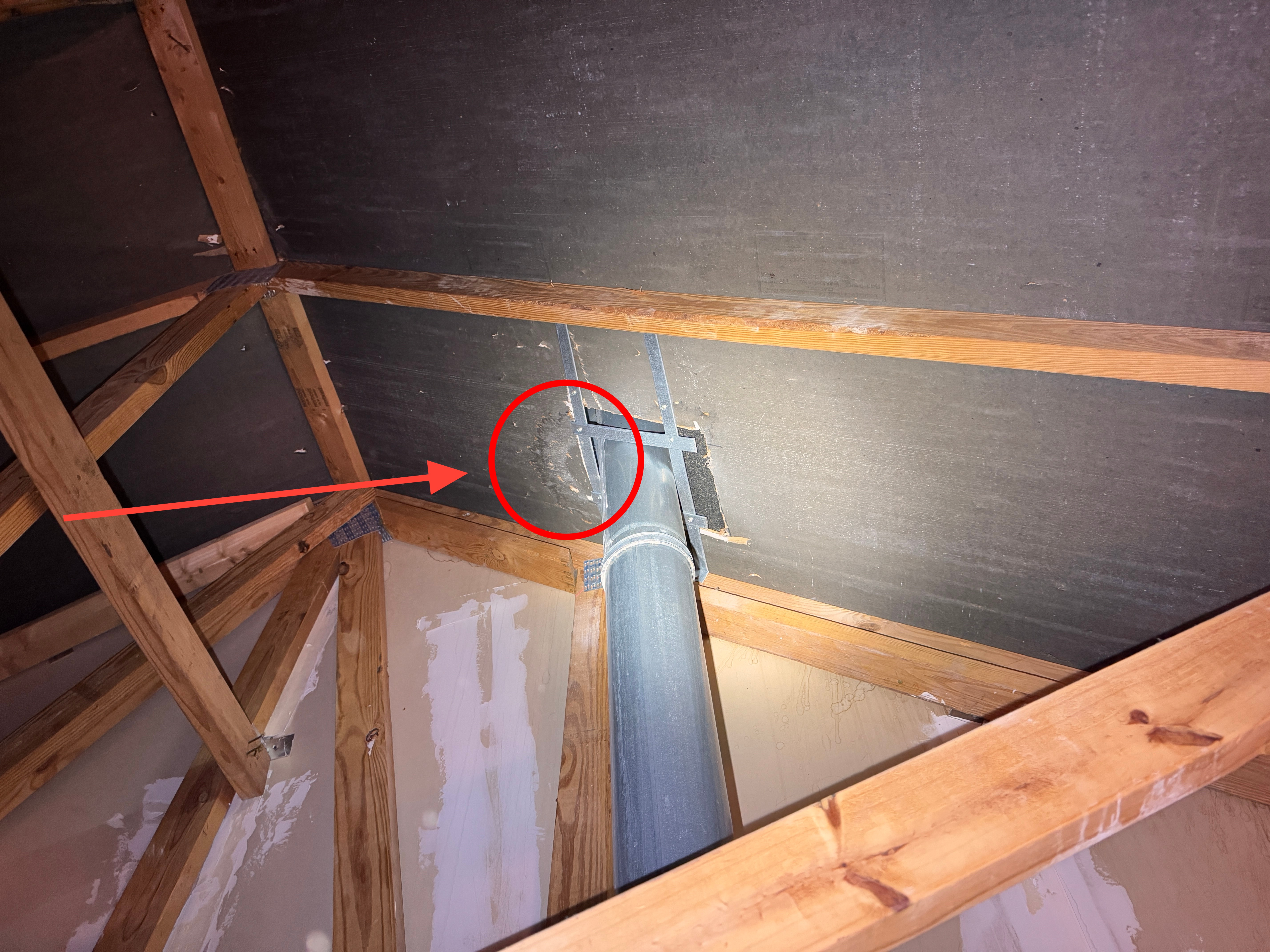
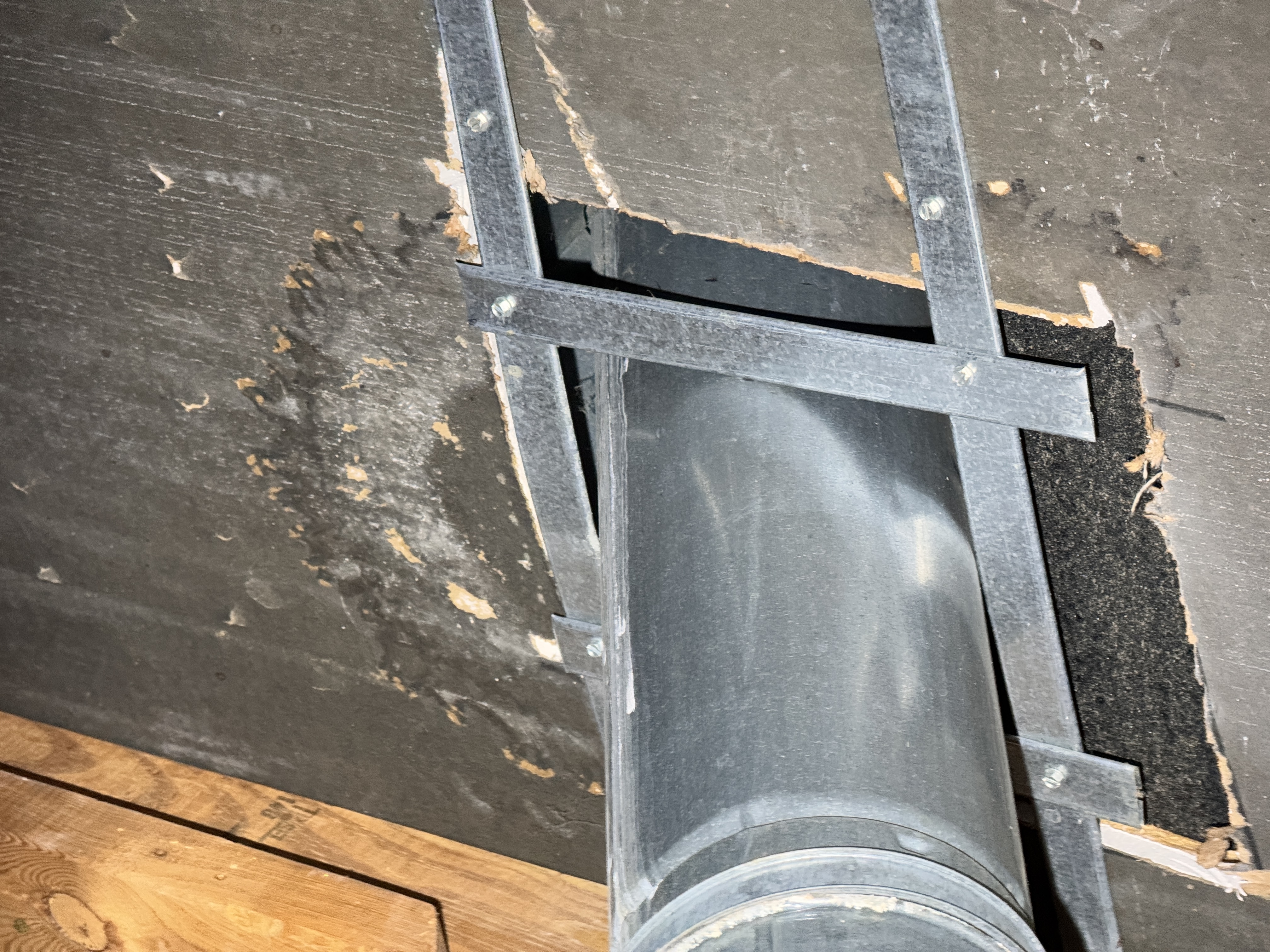
OLD STAINED NOTED
A stain was observed on the FRT plywood around the chimney flue, indicating a past moisture issue. No active moisture was detected on the insulation, suggesting the issue has been resolved. It is recommended to inspect the chimney flashing and monitor the area periodically to ensure no recurrence.
 |  |  |
Pictures of roof structure
 |  |
Fire Separation and Fire Blocking
Fire Blocking and Fire Separation in Attic: Not Fully Visible
Attic Insulation
Insulation Type: Fiberglass, Batt Insulation
Approximate Insulation R-Value on Attic Floor: Inconsistent
Approximate Insulation R-Value on Attic Ceiling: Not needed
Approximate Insulation R-Value on Attic Walls: Not applicable
BAFFLES NOT INSTALLED
Cardboard baffles have not been installed in the rafters near the eaves in the attic. This has allowed the fiberglass batt insulation to block ventilation from the soffit. This can inhibit proper ventilation of this roof cavity and can lead to heat build-up and seasonal moisture problems. It is recommend removing insulation away from the roof decking in these areas as is possible - this will be difficult work due to the tight space restrictions. Where possible baffles should be added though this could be difficult at this point.
 |  |  |
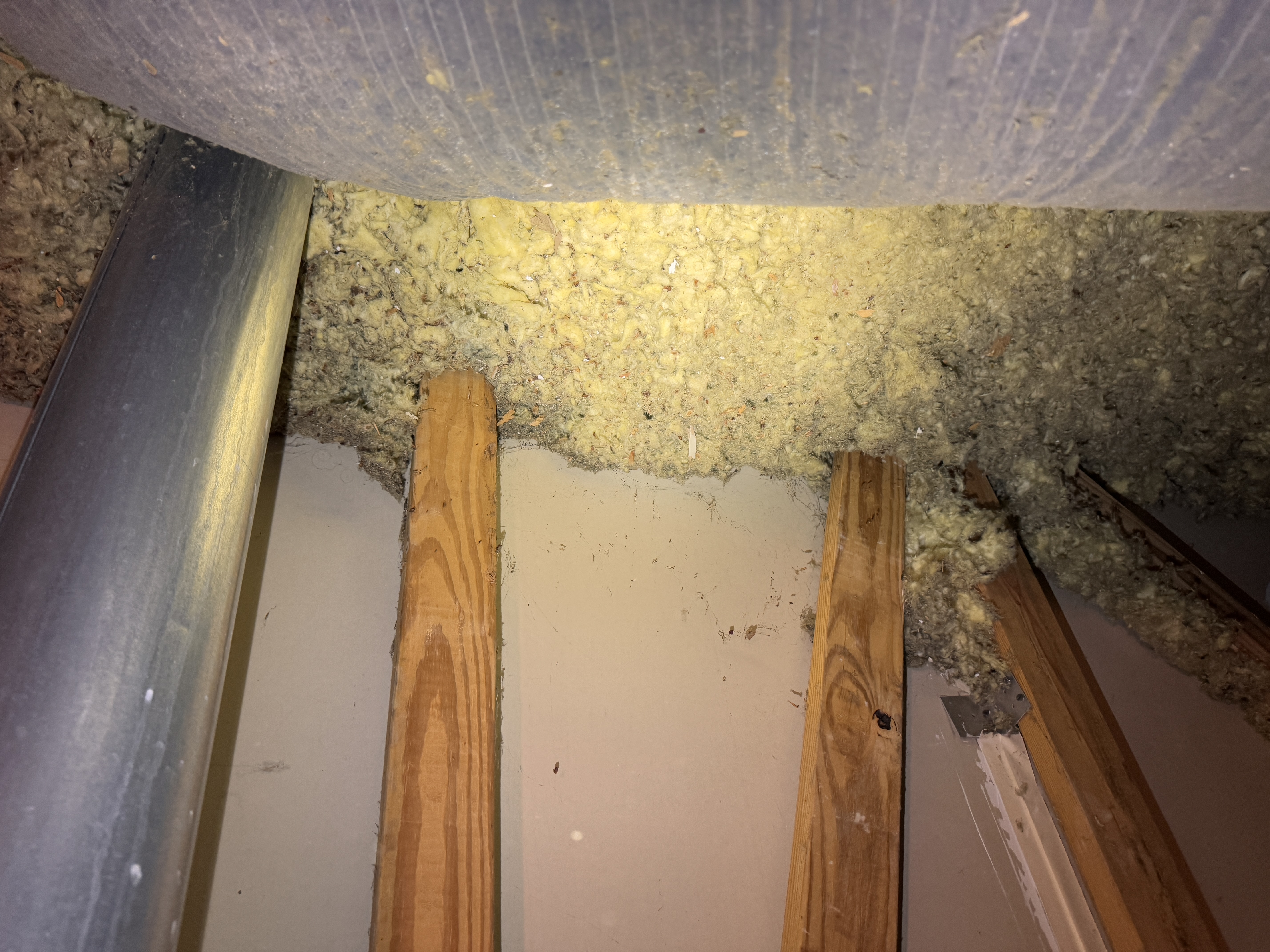
ATTIC INSULATION ADJUSTEMENT RECOMMENDED
Localized tune-up repairs are needed to the attic insulation to ensure reliable performance. During inspection the following observations were noted:
✒️
- Blown in insulation has been disturbed by contractors or prior attic access
 |  |
Attic Fan Exhaust Vents
The accessible exhaust fan vents in the attic were noted to be correctly terminating to the exterior where visible.
Attic and Roof Cavity Ventilation
Attic Ventilation Method: Soffit vents
Attic and roof cavity ventilation is a frequently misunderstood element of residential construction. All roof cavities are required to have ventilation. The general default standard is 1 to 150 of the attic area and ideally, this comes from at least 60% lower roof cavity ventilation and 40% upper, but this is an over-simplifications of the subject. As a good guiding principle the most important elements for healthy attic spaces, which are traditionally insulated and ventilated are:
- Make sure the ceiling between the living space and the attic is airtight
- Ventilate consistently across the whole lower part of the roof cavity with low, intake soffit venting
- Upper roof cavity venting is less important and if over-installed can exacerbate air migration into the attic from the living space.
- Avoid power ventilators which can depressurize the attic and exacerbate air migration from the house into the attic.
For more information, please see: Link
Structure and Basement
Foundation
% of Foundation Not Visible: 90%
Building Configuration: Basement
Foundation Description: Poured concrete
Floor, Wall and Ceiling Framing
Wall Framing: Partly visible, 2x4
Wall Sheathing: Not visible
Floor Framing: Partly visible, 2x8
Sub-Floor Material: Plywood
Ceiling Framing: Not visible
Basement
Finished
Basement Moisture
None noted
NO SIGNS OF BASEMENT MOISTURE WERE FOUND
I inspected all around the basement for signs of moisture and / or moisture control problems. No water stains, or damaged baseboard were noted and no signs of paint touch up near the floor. Basement did not smell musty at the time of inspection and seems to be performing well to date.

Checking Out Procedure
Check Out List
Oven:Off
Lights:Off
Heating and Cooling:Restored to Pre-inspection temperatures
Appliances:Off / finishing cycle
Signed Contracts

Home Inspections DMV, LLC
301-250-3711
www.inspectionsDMV.com
contact@inspectionsdmv.com
MD, D.C & VA State Inspector License No. MD 34937, VA 3380002208