


Plumber
How to Read This Report
This is a limited, visual, non-invasive inspection. It is not a warranty, a code inspection, or a technically exhaustive evaluation. See the Scope & Limitations chapter at the end of this report for full details.
Getting the Information to You
This report is designed to deliver important and technical information in a way that is easy for anyone to access and understand. If you are in a hurry, you can take a quick look at our "Summary Page” and quickly get critical information for important decision making. However, we strongly recommend that you take the time to read the full Report, which includes digital photographs, captions, diagrams, descriptions, videos and hot links to additional information. This report can also be printed on paper or to a PDF document, but the best way to get the layers of information that are presented in this report is to read your report online, which will allow you to expand your learning about the inspected property.
Chapters and Sections
This report is divided into chapters that parcel the home into logical inspection components. Each chapter is broken into sections that relate to a specific system or component of the home. You can navigate between chapters with the click of a button on the left side margin.
Most sections will contain some descriptive information done in black font. Observation narrative, done in colored boxes, will be included if a system or component is found to be significantly deficient in some way or if we wish to provide helpful additional information about the system or the scope of our inspection. If a system or component of the home was deemed to be in satisfactory or serviceable condition, there may be no narrative observation comments in that section and it may simply say “tested,” or “inspected.”
Observation Labels
All narrative observations are colored, numbered and labeled to help you find, refer to, and understand the severity of the observation. Observation colors and labels used in this report are:
- Note:Refers to aside information and/or any comments elaborating on descriptions of systems in the home or limitations to the home inspection. These also include contextual photos of the house and pictures of various components of the house while operating.
- Tier 1 - Major Concern:These represent priority items like major safety issues, active issues causing damage to the house, or items of significant expense that are looming in the near future.
- Tier 2 - Repair:These are lower priority deficiencies that may not need immediate attention, but should be addressed in the near/medium term future. These are usually deferred maintenance items, occupant safety concerns, or sub-par construction/installation problems.
- Tier 3 - Improve:These are things that are working but could be better. These are minor nuisance type concerns, or things related to safety, efficiency, or reliability issues. Often these are improvements that may not have been necessary--or even have existed--when the property being inspected was constructed (e.g. changes in building standards over time.)
- Future Project:A repair that may be deferred for some time but should be on the radar for repair or replacement in the future.
- Due Diligence:Observations that may require further investigation and/or clarification that could not be provided during the home inspection.
- Monitor:Items that should be watched to see if correction may be needed in the future.
- Recommended Maintenance:These are items that should be considered "routine home ownership," such as servicing the furnace, cleaning the gutters or changing the air filters in the furnace. Generally a house costs ~1% of the purchase price per year to maintain.
- Homeowner Info:These are pieces of "good to know" information about the house. For example, the location of the main water shut-off valve, gas shut-off valve(s), etc.
Summary Page
The Summary Page is a quick, bulleted overview of the observations from this inspection, grouped by category. The Tier 1, Tier 2, and Tier 3 sections list the deficiencies we found. The remaining sections, like Monitor, Due Diligence, Maintenance, and Homeowner Info, are listed for easy reference. This overview is not a substitution for reading the entire inspection report.
Plumber
Tier 1 - Major Concerns
- 6.4.1 Bathrooms:
Toilet was loosely mounted to the floor. This can allow the toilet to rock and slide when used, which damages the wax ring seal and can allow water to seep into the floor cavity. No leaks were detected, but the water was off so I could not accurately test the drain. The floor was slightly squishy around the toilet though, which is often a sign of water/rot damage. I recommend repair by a qualified plumber.
Contractor:Plumber - 11.5.3 Plumbing:
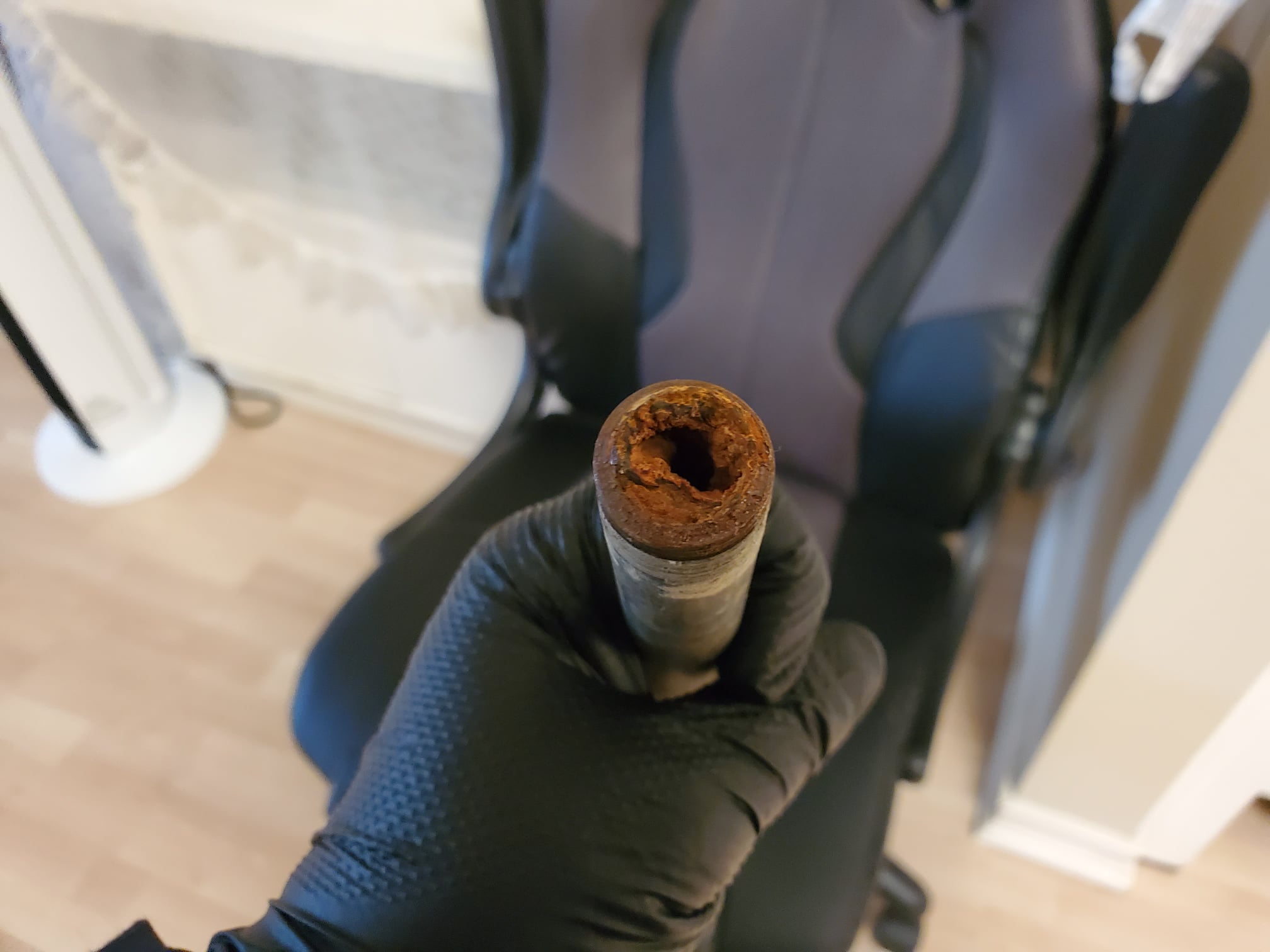
Galvanized steel plumbing was observed in the house, see example photo(s). The life expectancy of galvanized steel is 60 years, so it is due for replacement. Over time, galvanized steel will rust from the inside, which will:
- Make the pipes brittle, increasing the chance of leaks
- Reduce "functional flow", which is when the water flow drops significantly when multiple devices are drawing water.
I recommend replacement of galvanized plumbing by a qualified plumber. This is often an expensive repair, though the cost can be significantly reduced if done during remodeling projects.
Contractor:Plumber - 18.1.3 Sewer Scope:
The sewer scope was inconclusive due to the amount of debris/sludge in the pipe. Without running water, I could not keep my camera lens clean; I could not even see enough of the pipe to determine the materials it was made of. I recommend cleaning of the line (hydro-jetting is preferred) then an additional scope of the sewer line by a qualified plumber.
Note: Having this much solid waste in the line is an indicator that there is a significant blockage in the waste line. It appeared that liquids were making it down the pipe, but solids were not. Depending on what a successful scope finds, this could be an expensive repair.
Contractor:Plumber



Tier 2 - Repairs
- 11.7.4 Plumbing:
The discharge tube for the water heater temperature and pressure relief valve was installed too high off the ground, see photo(s). Discharge tubes should always terminate by pointing toward the ground to eliminate a scald hazard (they will vent steam or hot water) and should be no more than 6" off the ground. Ideally, the discharge tube terminates to an exterior, unfinished location, or above a drain, though this is not always possible. The discharge location should be visible so it can be monitored. I recommend repair by a qualified plumber.
Contractor:Plumber

Tier 3 - Improvements
- 6.3.1 Bathrooms:
Flexible/accordion drain lines are not recommended as they can be prone to clogging, see photo(s). I recommend monitoring and cleaning these drains regularly. For a more permanent solution, recommend contacting a qualified plumber to replace the flexible drain with straight pipes, which will not clog as easily.
Contractor:Plumber - 11.7.5 Plumbing:
An expansion tank was not installed. This device helps reduce pressure on the plumbing system when the pipes and water expand from thermal expansion during water heating. These are only required when a backflow prevention device is installed on the plumbing system; most houses (but not all) have some sort of backflow prevention device, though it might not be visible. I recommend evaluation of the system and installation of an expansion tank by a qualified plumber if needed.
Contractor:Plumber
