




The Scope and Purpose of a Home Inspection
Purchasing property involves risk
The purpose of a home inspection is to help reduce the risk associated with the purchase of a structure by providing a professional opinion about the overall condition of the structure. A home inspection is a limited visual inspection, and it cannot eliminate this risk. Some homes present more risks than others. We cannot control this, but we try to help educate you about what we don’t know during the inspection process. This is more difficult to convey in a report and one of many reasons why we recommend you attend the inspection.
A home inspection is not an insurance policy
This report does not substitute for or serve as a warranty or guarantee. Home warranties can be purchased separately from insuring firms that provide this service.
A home inspection is visual and not destructive
The descriptions and observations in this report are based on a visual inspection of the structure. We inspect the aspects of the structure that can be viewed without dismantling, damaging, or disfiguring the structure and without moving furniture and interior furnishings. Areas that are concealed, hidden, or inaccessible to view are not covered by this inspection. Some systems cannot be tested during this inspection as testing risks damaging the building. For example, overflow drains on bathtubs are generally not tested because if they were found to be leaking, they could damage the finishes below. Our procedures involve non-invasive investigation and non-destructive testing, which will limit the scope of the inspection.
This is not an inspection for code compliance
This inspection and report are not intended for city / local code compliance. During the construction, process structures are inspected for code compliance by municipal inspectors. Framing is open at this time, and conditions can be fully viewed. Framing is not open during inspections of finished homes, limiting the inspection. All houses fall out of code compliance shortly after they are built, as the codes continually change. National codes are augmented at least every three years for all disciplines. Municipalities can adopt and phase in sections of the codes on their timetables. There are generally no requirements to bring older homes into compliance unless substantial renovation is being done.
This is just our opinion
Construction techniques and standards vary. There is no one way to build a house or install a system in a house. The observations in this report are the opinions of the home inspector. Other inspectors and contractors are likely to have some differing opinions. You are welcome to seek opinions from other professionals.
The scope of this inspection
This inspection will include the following systems: exterior, roof, structure, drainage, foundation, attic, interior, plumbing, electrical, and heating. The evaluation will be based on limited observations that are primarily visual and non-invasive. This inspection and report are not intended to be technically exhaustive.
Your expectations
The overall goal of a home inspection is to help ensure that your expectations are appropriate for the house you are proposing to buy or planning to sell. To this end, we assist with the discovery by showing and documenting observations during the home inspection. This should not be mistaken for a technically exhaustive inspection designed to uncover every defect in a building. Such inspections are available, but they are generally cost-prohibitive to most homebuyers.
Your participation is requested
Your presence is requested during this inspection. A written report will not substitute for all the possible information that can be conveyed verbally by a shared visual observation of the conditions of the property.
How to Read This Report
Getting the Information to You
This report is designed to deliver important and technical information in a way that is easy for anyone to access and understand. If you are in a hurry, you can take a quick look at our "Summary Page” and quickly get the critical information for important decision-making. However, we strongly recommend that you take the time to read the full Report, which includes digital photographs, captions, diagrams, descriptions, videos, and hot links to additional information.
The best way to get the layers of information presented in this report is to read your report online, which will allow you to expand your learning about your house. You will notice some words or series of words highlighted in blue and underlined – clicking on these will provide you with additional information.
This report can also be printed to a PDF file and printed on paper as desired.
Chapters and Sections
This report is divided into chapters that parcel the home into logical inspection components. Each chapter is broken into sections that relate to a specific system or component of the home. You can navigate between chapters with the click of a button on the left-side margin.
Most sections will contain some descriptive information in black font. Observation narrative, done in colored boxes, will be included if a system or component is found to be significantly deficient in some way or if we wish to provide helpful additional information about the system or the scope of our inspection. If a system or component of the home was deemed to be in satisfactory or serviceable condition, there might be no narrative observation comments in that section, and it may simply say “tested” or “inspected.”
Observation Labels
All narrative observations are colored, numbered, and labeled to help you find, refer to, and understand the severity of the observation. Observation colors and labels used in this report are:
- Significantly Deficient:Items that require immediate attention to prevent additional damage or eliminate safety hazards.
- Repair/Replace:Items that are not functioning as intended that may need repair or replacement, or anything that may lead to more serious problems if not addressed.
- Watchlist:Items that are recommended to be monitored to see if correction may be needed in the future or nearing the end of its service life.
- Recommended Maintenance:Items that may be considered part of "routine home ownership tasks," such as servicing the furnace, cleaning the gutters or changing the air filters in the furnace.
- Evaluation Needed:Observations that may require further investigation by a qualified professional to determine the severity and/or urgency of repair.
- Improve:Observations that are not necessarily defects but which could be improved for safety, efficiency, or reliability reasons.
- Note:Refers to information and/or any comments elaborating on descriptions of systems in the home or limitations to the home inspection.
- Description:Detailed description of various aspects of the property noted during the inspection.
Summary Page
The Summary Page is designed as a bulleted overview of all the observations noted during the inspection. This helpful overview is not a substitute for reading the entire inspection report. The entire report must be read to get a complete understanding of this inspection report, as the Summary Page does not include photographs or photo captions.
Moisture Meter Testing
Where moisture meter testing is indicated in this report, a Klein ET140 or Protimeter Moisture Meter was used.
Summary
Significantly Deficients
- E1-2 Electrical:
In the electrical service panel, branch conductors had been labeled with tape and some are missing. This indicates that circuits were not identified by a qualified electrical contractor and labels may be inaccurate. A properly-marked circuit directory should be installed by a qualified electrical contractor to help ensure that individual circuits can be quickly and accurately identified and shut off during an emergency.
- E1-6 Electrical:
Several receptacles in the living area and bedrooms were found to be improperly wired. In the bedroom, a couple of outlets were only showing approximately 30 volts, indicating a wiring or connection defect. Improperly wired receptacles present both safety and functional concerns. Recommend evaluation and correction of all affected circuits by a qualified electrician
- E-6 Exterior:
Chimney height should comply with the 3-2-10 rule: a minimum of 3 feet above the roof penetration point and at least 2 feet higher than any structure within 10 horizontal feet. This ensures safe draft performance and minimizes the risk of backdrafting or fire hazards. Recommend evaluation of chimney height and clearance by a qualified contractor or chimney specialist.
- I-7 Interior:
A railing was missing at the landing of the U-shaped staircase. Missing railings present a fall hazard and are not consistent with modern safety standards. Recommend installation of a properly secured handrail/guard by a qualified contractor for improved safety.
- I-8 Interior:
The stairway headroom was measured to be lower than current safety standards, creating a potential safety hazard. Modern standards require a minimum headroom clearance of 6 feet 8 inches. Reduced clearance increases the risk of impact injuries when using the stairs. Recommend correction where feasible to improve safety.
- I-9 Interior:
Surface-mounted incandescent or LED luminaires must have a completely enclosed light source. Exposed bulbs are a fire hazard.
- I-16 Interior:
The dryer duct should be constructed of rigid or semi-rigid metal material with a smooth interior and proper termination to the exterior. Flexible plastic or foil ducts are not considered safe or code-compliant for permanent dryer venting.
- I-18 Interior:
Where the dryer exhaust duct terminated at the home exterior a screen was installed to prevent pest entry. Screens can trap lint, a potential fire hazard. The screen should be replaced with a damper designed for this purpose.
- I-21 Interior:
Inadequate smoke and carbon monoxide (CO) detectors were observed in the home. Current safety standards recommend smoke detectors on each level of the home, inside every bedroom, and outside each sleeping area. CO detectors are recommended on each level and outside sleeping areas when fuel-burning appliances or an attached garage are present. Recommend installation of detectors in accordance with modern safety standards for improved protection.
- K-8 Kitchen:
The range was not fastened to the floor/wall. For important safety reasons, an approved anti-tip device should be installed by qualified personnel.
Repair Replaces
- A-5 Attic:
A bathroom exhaust duct in the attic was observed to be bent and disconnected from the roof vent termination. This condition allows warm, moisture-laden air to discharge directly into the attic space, which can contribute to elevated humidity, condensation, and potential mold growth or material deterioration. Recommend repair by a qualified contractor to properly reconnect and secure the duct to an exterior vent termination.
- E1-4 Electrical:
The electrical service panel cover was observed to have been painted. Painted panel covers can obscure labeling, hinder proper removal, and may indicate prior unprofessional work. Recommend replacement of the painted cover or correction by a qualified electrician to ensure safe access and clear identification.
- E1-5 Electrical:
At the electrical service panel, screws holding the dead front cover in place were pointed, course-thread screws that can damage conductors, potentially causing electrical arcing (with risk of eye injury and burns), or can energize the metal panel (with risk of electrical shock or electrocution). Proper screws should be installed by a qualified electrical contractor.
- E-2 Exterior:
Vertical soil movement beneath walkway pavement in areas has created trip hazards that should be corrected by a qualified contractor.
- E-4 Exterior:
The wood siding was observed to be in direct contact with the ground. Standard practice requires at least 6–8 inches of clearance between siding and soil to reduce the risk of moisture damage and insect activity. Direct ground contact can trap moisture, leading to decay and observable biological growth, as noted. Recommend correction by a qualified professional.
- E-5 Exterior:
An exterior receptacle (front and garage) was observed that is not GFCI-protected. Current safety standards require exterior outlets to be GFCI-protected to reduce the risk of electrical shock. Recommend replacement or modification by a licensed electrician to provide proper GFCI protection.
- E-8 Exterior:
Stepped cracking was visible in areas of the brick mortar joints. This condition is typically the result of foundation movement. You should consult with a qualified contractor to gain an idea of options and costs for crack repair and foundation stabilization as necessary.
- E-9 Exterior:
Vinyl siding was damaged in areas. Damaged siding should be replaced to help prevent wall damage from moisture intrusion.
- G-3 Garage:
The garage door opener did not reverse when tested with a 2x4 placed on the floor in the door’s path. This indicates that the safety reverse feature is not functioning properly. A non-operational safety reverse presents a significant risk of injury or damage. Recommend adjustment, repair, or replacement of the opener by a qualified garage door contractor for improved safety.
- G-5 Garage:
The door between the garage and living space is missing an automatic door closer. This safety feature is required to help ensure the door self-closes, maintaining the fire separation and preventing fumes from entering the living area. Recommend installation by a qualified contractor.
- H-4 HVAC:
The gas supply line enters the furnace cabinet without a protective grommet or bushing. Penetrations through sheet metal should be protected to prevent abrasion and potential damage to the gas line. Recommend installation of an approved grommet or fitting by a qualified HVAC or plumbing contractor to ensure safe conditions.
- H-5 HVAC:
The furnace air filter was the wrong size. This condition can allow particulates to pass beyond the filter and into indoor air or may result in the filter being sucked into the blower, causing damage to the blower and creating a potential fire hazard. The filter should be replaced with one of the proper size.
- I-5 Interior:
One of the double-hung bedroom windows was observed with a puncture in the glass. Damaged glazing can reduce energy efficiency, present a safety hazard, and may worsen over time. Recommend repair or replacement of the affected window by a qualified contractor.
- I-6 Interior:
The exterior casement window appears damaged, with visible holes and cracks on the frame and signs of missing or broken glass. This condition can allow water intrusion, air leaks, and may pose a safety concern. Recommend further evaluation and repair or replacement by a qualified window contractor to restore proper function and weather resistance.
- I-11 Interior:
The faucet was observed to be loosely attached. Loose fixtures may worsen with use and could lead to leaks or damage to surrounding finishes. Recommend securing or repairing the faucet by a qualified contractor or plumber.
- I-13 Interior:
Elevated moisture levels were detected in the ceiling area directly below an upstairs bathroom using a moisture meter. This may indicate an active or previous leak from plumbing fixtures, drains, or supply lines above. No visible staining or damage may be present at this time, but hidden deterioration is possible. Recommend further evaluation by a licensed plumber or contractor to identify the source and address any necessary repairs. Ceiling material should also be monitored or opened as needed to assess for concealed damage or mold.
- I-14 Interior:
The bathroom mirrors appear to be loosely secured and could be easily detached if pulled. This condition presents a potential safety hazard and should be properly fastened.
- I-17 Interior:
No ground fault circuit interrupter (GFCI) protection of laundry room electrical receptacles was provided in the laundry room at the time of inspection. Good electrical safety practice recommends that electrical receptacles located within 6 feet of a plumbing fixture be provided with ground fault circuit interrupter (GFCI) protection. This can be achieved relatively inexpensively. You should consult with a qualified electrical contractor to discuss options and costs.
- K-2 Kitchen:
The dishwasher drain line is currently discharging into an open standpipe without a sealed connection. This setup increases the risk of wastewater backups or overflows, particularly if the pipe becomes partially obstructed. A drip tray observed at the base of the cabinet suggests there may have been past instances of overflow. Recommend evaluation and correction by a licensed plumber. The drain line should be properly terminated with a code-compliant connection to prevent potential backflow or water damage.
- K-6 Kitchen:
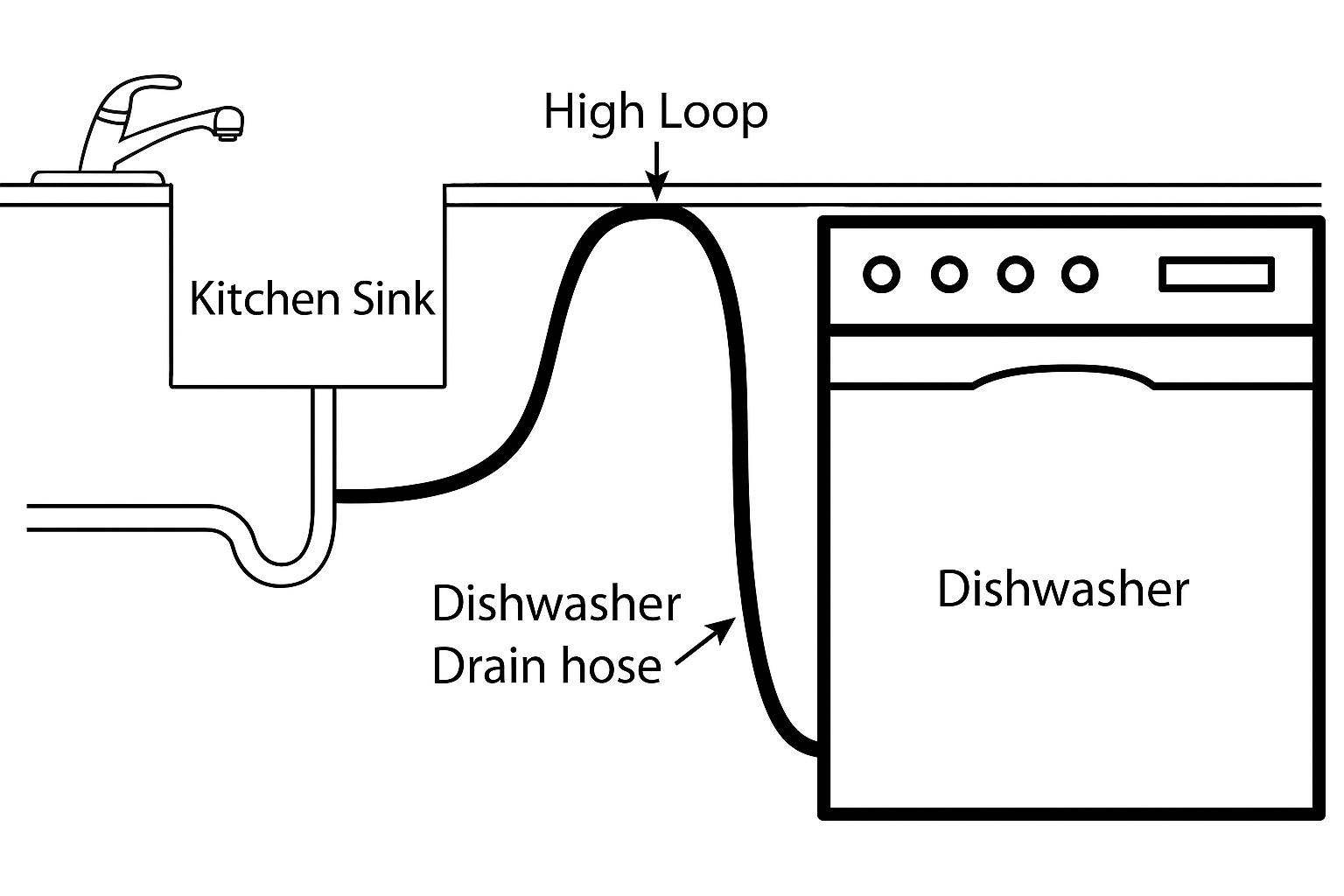
The dishwasher drain line was not installed with a required high loop. A high loop (or air gap, where required) prevents wastewater from the sink from backflowing into the dishwasher. Recommend correction by a qualified plumber or appliance technician to ensure proper installation and sanitation.
- P-4 Plumbing:
The water heater may interrupt the electrical continuity of the pipes, compromising the effectiveness of the ground. A bonding jumper should be installed across the water heater's hot and cold pipes by a qualified electrical contractor.
- P-5 Plumbing:
The water heater vent duct was observed to be sealed with foil tape. This material is not approved for venting connections, as it may fail under high heat and allow combustion gases to escape. Recommend repair by a qualified contractor using approved mechanical fasteners and high-temperature sealant.
- R-1 Roof:
The home had no kick-out flashing installed where walls extended past roof eaves. This condition increases the potential for significant wall damage from moisture intrusion. You consult with a qualified roofing contractor to discuss options and costs for installation of kickout flashing.
- R-4 Roof:
Roof drainage system downspouts discharged drainage next to the foundation. To avoid possible damage from soil/foundation movement that can result from high soil moisture levels, downspout extensions should be installed to discharge roof drainage away from the foundation at least 6ft.
Watchlists
- E-1 Exterior:
A young tree planted close to the home appeared to be of a species that will grow to large size. To avoid eventual damage to the home and the tree, it should be moved while it is still small.
- K-5 Kitchen:
Whirlpool dishwasher. Manufactured likely to be mid-to-late 1980s through the early 1990s. Dishwasher typical lifespan is 9 years.
- K-11 Kitchen:
Samsung refrigerator. 2014 date of manufacture. Refrigerator typical lifespan is between 9-13 years. Monitor. Nearing the end of typical service life.
- P-3 Plumbing:
Richmond 50 gal water heater. Manufactured in 2011. Water heater typical lifespan is 6-12 years. Monitor and consider replacing as it's already beyond its typical service life.
Recommended Maintenance Items
- I-20 Interior:
The firebox of the wood-burning fireplace was dirty. It should be serviced by a qualified contractor.
- K-3 Kitchen:
Braided supply lines were observed at the toilets, bathroom sinks, and kitchen sink. These lines should be replaced every 5–10 years as part of routine maintenance to reduce the risk of leaks and water damage.
- R-2 Roof:
Debris accumulated in the gutters should be removed by a qualified contractor to encourage proper drainage.
- R-6 Roof:
Tree branches were observed in contact with the roof surface. This condition can cause shingle damage, accelerate wear, and provide a pathway for pests. Recommend trimming back vegetation to provide at least 10 feet of clearance from the roof to help protect the roofing materials and maintain proper ventilation.
Evaluation Neededs
- E1-3 Electrical:
The electrical service panel interior was contaminated with paint overspray. This condition can deteriorate electrical connections, a potential fire hazard. The panel should be serviced by a qualified electrical contractor.
- G-2 Garage:
The garage door tracks and opener were observed to be attached through drywall rather than directly to structural framing. This condition may result in loosening, misalignment, or failure over time. Recommend evaluation and correction by a qualified garage door contractor to ensure proper attachment to framing members.
- I-2 Interior:
Finished flooring on both the first and second floors shows signs of sinking. Recommend further evaluation by a licensed structural engineer to assess the integrity of the support system and determine appropriate corrective measures.
- K-10 Kitchen:
When tested, the range hood did not appear to be operating in recirculation mode and is designed to vent to the exterior. However, when the fan was turned on, the adjacent exterior vent louvers did not open. This condition suggests the duct may be disconnected, blocked, or venting elsewhere. Recommend further evaluation and correction by a qualified contractor to ensure proper exterior venting.
Improves
- A-2 Attic:
The attic hatch cover was observed without insulation. Uninsulated attic access panels can contribute to heat loss, reduced energy efficiency, and uneven indoor temperatures. Recommend adding insulation to the hatch cover to match the surrounding attic insulation level for improved performance.
- A-6 Attic:
The attic was observed to have blown-in cellulose insulation, but at an insufficient depth. Inadequate insulation can reduce energy efficiency and result in uneven indoor temperatures. For cellulose, achieving the recommended R-49 typically requires a thickness of about 15–18 inches, depending on installation density. Recommend adding insulation to meet or exceed this level for improved comfort and efficiency.
- I-12 Interior:
The under-sink drain assembly was observed to include a flexible drain pipe. Flexible piping is not considered a durable or approved material for permanent drainage, as it is more prone to clogging and leakage. Recommend replacement with a smooth, rigid drain pipe by a qualified plumber for improved reliability.
- P-6 Plumbing:
No drip pan was installed beneath the water heater. While an adjacent floor drain is present, the water heater is located in a finished area where leakage could cause damage. Installation of a properly drained drip pan is recommended.
- P-8 Plumbing:
The sump pump discharge pipe had no backwater or check valve installed as is typically recommended by sump pump manufacturers. An appropriate valve should be installed by a qualified plumbing contractor.
- R-3 Roof:
IA section of gutter was observed to terminate directly onto the roof surface rather than into the adjacent gutter. This condition can concentrate water flow, leading to premature roof wear and increased risk of leaks at that location. Recommend redirecting or extending the gutter to properly discharge into the adjoining gutter.
Notes
- H-9 HVAC:
A whole-home humidifier was observed. For best use, the humidifier should typically be turned on during the heating season (fall and winter months) when indoor air becomes dry, and off during the cooling season (spring and summer) to prevent excess moisture and potential mold growth. Regular maintenance, including annual cleaning and replacement of the water panel, is recommended for proper operation.
Descriptions
- A-1 Attic:
Attic Hatch found in the primary room's closet
- A-3 Attic:
General attic photos
- A-4 Attic:
Powered roof vent
- E1-1 Electrical:
Electric meter found at the rear of the home
- E-3 Exterior:
General exterior doors photos
- E-7 Exterior:
General brick exterior photo
- G-1 Garage:
General garage photos
- G-4 Garage:
1/2 hp. Manufactured in 1993. Typical lifespan is 10-15 years.
- H-1 HVAC:
Thermostat found in the hallway close to the kitchen
- H-2 HVAC:
Good man natural gas furnace. Appears to be manufactured in 2021. Furnace typical lifespan is between 15-25 years.
- H-3 HVAC:
Heating temperature differential was measured between the return air and the supply register.
- H-6 HVAC:
Lennox 3.5 ton AC condenser. Date of manufacture is 2018. AC condenser typical lifespan is 8-20 years.
- H-7 HVAC:
Cooling temperature differential was measured between the return air and the supply register.
- H-8 HVAC:
General humidifier photos. Typical lifespan is 12 years.
- I-1 Interior:
Floors (Carpet and Wood Laminate)
- I-3 Interior:
General interior door photos
- I-4 Interior:
General window photos
- I-10 Interior:
General bathroom photos
- I-15 Interior:
LG electric washer and dryer. They appear to be manufactured in 2024.
- I-19 Interior:
Fireplace photos
- K-1 Kitchen:
General kitchen photo
- K-4 Kitchen:
1HP Insinkerator Garbage disposal
- K-7 Kitchen:
General range photo
- K-9 Kitchen:
General range hood photo
- P-1 Plumbing:
Water meter and main shutoff
- P-2 Plumbing:
Drain clean out access found in the laundry room
- P-7 Plumbing:
Main gas shut off valve and meter
- R-5 Roof:
Asphalt Architectural Shingles
- YRII-1 YOUR REVIEW IS IMPORTANT:
Thank you for trusting Chicago Home Inspect LLC with your recent home inspection—we know you have choices, and we’re grateful you chose us.
If you were pleased with our service, would you mind leaving a quick Google review? Your feedback helps fellow Chicago-area homeowners find an inspector they can rely on.
Thanks again for choosing us!
Leave us a review on Google
The Full Report
Attic
Attic Access
Attic Conditions
Attic Ventilation
Thermal Insulation
Conventional Roof Framing
Roof Sheathing
Exterior
Grounds
Driveway
Walkways
Wall Exteriors
Exterior Doors
Exterior Trim
Porch
Patio
Chimney
Brick Exterior
Vinyl Siding
Garage
Garage Description
Garage Doors and Framing
Automatic Opener
Floors, Walls, and Ceiling
Garage Electrical
Access to Living Space
Garage Ventilation
Interior
Floors
Walls
Ceilings
Ceiling Fan
Interior Doors
Windows
Stairways
Bedroom
Bathroom
Washer and Dryer
Fireplace
General Hazards
General Comments
Building Characteristics, Conditions and Limitations
Style of Home: Colonial
Type of Building : Single Family (2-story)
Approximate Square Footage: 1400
Approximate Year of Original Construction: 1988
Attending the Inspection: Buyer and Buyer's Agent, Buyer's Family
Occupancy: Unoccupied
Animals Present: No
Weather during the inspection: Partly cloudy
Approximate temperature during the inspection: Over 70[F]
Ground/Soil surface conditions: Damp
For the Purposes of This Report, the Front Door Faces: North
Attic
Attic Access
Inspected: Yes
Attic inspection method: From the hatch
Access hatch type and location: Ceiling hatch, Master bedroom closet
Attic Hatch found in the primary room's closet

The attic hatch cover was observed without insulation. Uninsulated attic access panels can contribute to heat loss, reduced energy efficiency, and uneven indoor temperatures. Recommend adding insulation to the hatch cover to match the surrounding attic insulation level for improved performance.

Attic Conditions
General attic photos
 |  |  |
 |
Attic Ventilation
Attic Ventilation Method: Individual roof vents, Soffit vents, Gable vents
Powered roof vent
 |  |
A bathroom exhaust duct in the attic was observed to be bent and disconnected from the roof vent termination. This condition allows warm, moisture-laden air to discharge directly into the attic space, which can contribute to elevated humidity, condensation, and potential mold growth or material deterioration. Recommend repair by a qualified contractor to properly reconnect and secure the duct to an exterior vent termination.
 |  |  |
Thermal Insulation
Application Type: Attic is outside the thermal envelope
Insulation Average Depth: 3-6 inches
Thermal Insulation Type: Blown fiberglass
The attic was observed to have blown-in cellulose insulation, but at an insufficient depth. Inadequate insulation can reduce energy efficiency and result in uneven indoor temperatures. For cellulose, achieving the recommended R-49 typically requires a thickness of about 15–18 inches, depending on installation density. Recommend adding insulation to meet or exceed this level for improved comfort and efficiency.
Conventional Roof Framing
Roof framing method: Conventional framing
Roof Sheathing
Roof Sheathing Material: 3/4-inch plywood
Electrical
Service Drop
Service conductors: 3-wire (120/240V), Copper
Service type: Underground
Type of attachment: Side of structure
Electric Meter
Electric meter location: Rear
Electric meter type: Solid state (LCD)
Electric meter found at the rear of the home

Service Entrance Cables
Service entrance cable ampacity: #2 aluminum/100 amps
Viewed service entrance conductors at:: In the service panel
Service Panel
Inspected: Yes
Main disconnect ampacity: 100 amps
Main disconnect type: Breaker
Overcurrent protection type: Circuit breakers
Service panel ampacity: 100 amps
Service panel brand: Westinghouse
Service panel location: Main floor, Kitchen
Service panel type: Flush mount
In the electrical service panel, branch conductors had been labeled with tape and some are missing. This indicates that circuits were not identified by a qualified electrical contractor and labels may be inaccurate. A properly-marked circuit directory should be installed by a qualified electrical contractor to help ensure that individual circuits can be quickly and accurately identified and shut off during an emergency.
 |  |
The electrical service panel interior was contaminated with paint overspray. This condition can deteriorate electrical connections, a potential fire hazard. The panel should be serviced by a qualified electrical contractor.
 |  |  |
The electrical service panel cover was observed to have been painted. Painted panel covers can obscure labeling, hinder proper removal, and may indicate prior unprofessional work. Recommend replacement of the painted cover or correction by a qualified electrician to ensure safe access and clear identification.

At the electrical service panel, screws holding the dead front cover in place were pointed, course-thread screws that can damage conductors, potentially causing electrical arcing (with risk of eye injury and burns), or can energize the metal panel (with risk of electrical shock or electrocution). Proper screws should be installed by a qualified electrical contractor.

Branch Circuits & Devices
Branch Circuit Conductor Type: Copper
Ground fault circuit interruption (GFCI) protection method: GFCI receptacles
Several receptacles in the living area and bedrooms were found to be improperly wired. In the bedroom, a couple of outlets were only showing approximately 30 volts, indicating a wiring or connection defect. Improperly wired receptacles present both safety and functional concerns. Recommend evaluation and correction of all affected circuits by a qualified electrician
 |  |  |
Exterior
Grounds
Fence material: Wood
A young tree planted close to the home appeared to be of a species that will grow to large size. To avoid eventual damage to the home and the tree, it should be moved while it is still small.
 |  |
Driveway
Inspected: Yes
Driveway surface material: Asphalt
Walkways
Inspected: Yes
Walkway Materials: Concrete
Vertical soil movement beneath walkway pavement in areas has created trip hazards that should be corrected by a qualified contractor.
 |  |
Wall Exteriors
Inspected: Yes
Exterior Doors
Inspected: Yes
Exterior door materials: Metal, Vynil, Hollow core
General exterior doors photos
 |  |  |
The wood siding was observed to be in direct contact with the ground. Standard practice requires at least 6–8 inches of clearance between siding and soil to reduce the risk of moisture damage and insect activity. Direct ground contact can trap moisture, leading to decay and observable biological growth, as noted. Recommend correction by a qualified professional.
 |  |  |
Exterior Trim
Trim Material: Wood, Vinyl
Porch
Inspected: Yes
Porch Location: Front
An exterior receptacle (front and garage) was observed that is not GFCI-protected. Current safety standards require exterior outlets to be GFCI-protected to reduce the risk of electrical shock. Recommend replacement or modification by a licensed electrician to provide proper GFCI protection.
 |  |  |
Patio
Patio Location: Rear of home
Patio Materials: Poured concrete
Chimney
Chimney Construction: Brick
Flue: Clay
Raincap: Present
Crown Material: Mortar
Chimney height should comply with the 3-2-10 rule: a minimum of 3 feet above the roof penetration point and at least 2 feet higher than any structure within 10 horizontal feet. This ensures safe draft performance and minimizes the risk of backdrafting or fire hazards. Recommend evaluation of chimney height and clearance by a qualified contractor or chimney specialist.
 |  |  |
Brick Exterior
Inspected: Yes
Type of brick Installation: Brick cladding over wood frame
General brick exterior photo

Stepped cracking was visible in areas of the brick mortar joints. This condition is typically the result of foundation movement. You should consult with a qualified contractor to gain an idea of options and costs for crack repair and foundation stabilization as necessary.

Vinyl Siding
Inspected: Yes
Vinyl siding was damaged in areas. Damaged siding should be replaced to help prevent wall damage from moisture intrusion.
 |  |
Garage
Garage Description
Garage Description: Attached, 2-car
General garage photos
 |  |
Garage Doors and Framing
Inspected: Yes
Material: Aluminum
The garage door tracks and opener were observed to be attached through drywall rather than directly to structural framing. This condition may result in loosening, misalignment, or failure over time. Recommend evaluation and correction by a qualified garage door contractor to ensure proper attachment to framing members.
 |  |
The garage door opener did not reverse when tested with a 2x4 placed on the floor in the door’s path. This indicates that the safety reverse feature is not functioning properly. A non-operational safety reverse presents a significant risk of injury or damage. Recommend adjustment, repair, or replacement of the opener by a qualified garage door contractor for improved safety.

Automatic Opener
Inspected: Yes
Garage Door Opener Type: Automatic chain drive
Number of Automatic Openers: 1
1/2 hp. Manufactured in 1993. Typical lifespan is 10-15 years.
 |  |  |
Floors, Walls, and Ceiling
Inspected: Yes
Flooring: Concrete Slab
Walls: Finished, Wood board, Drywall
Ceiling: Finished, Drywall
Garage Electrical
Inspected: Yes
Access to Living Space
The door between the garage and living space is missing an automatic door closer. This safety feature is required to help ensure the door self-closes, maintaining the fire separation and preventing fumes from entering the living area. Recommend installation by a qualified contractor.

Garage Ventilation
Inspected: Yes, Gable
HVAC
Heating System
Inspected: Yes
Heating Type: Furnace
Air filter type: Pleated
Air Filter Location: Sliding panel at furnace
Duct Type: Sheet metal
Energy Source: Natural gas
Equipment Brand: Goodman
Equipment Location: Utility room, Main floor
Thermostat found in the hallway close to the kitchen

Good man natural gas furnace. Appears to be manufactured in 2021. Furnace typical lifespan is between 15-25 years.
 |  |
Heating temperature differential was measured between the return air and the supply register.
 |  |
The gas supply line enters the furnace cabinet without a protective grommet or bushing. Penetrations through sheet metal should be protected to prevent abrasion and potential damage to the gas line. Recommend installation of an approved grommet or fitting by a qualified HVAC or plumbing contractor to ensure safe conditions.

The furnace air filter was the wrong size. This condition can allow particulates to pass beyond the filter and into indoor air or may result in the filter being sucked into the blower, causing damage to the blower and creating a potential fire hazard. The filter should be replaced with one of the proper size.

Cooling System
Inspected: Yes
Brand: Lennox
Condenser Location: Side
Energy source: Electric
Size: 3.5 tons or 42,000 BTUH
Lennox 3.5 ton AC condenser. Date of manufacture is 2018. AC condenser typical lifespan is 8-20 years.
 |  |
Cooling temperature differential was measured between the return air and the supply register.
 |  |
Humidifier
Humidifier Type: Evaporative, Whole Home
General humidifier photos. Typical lifespan is 12 years.
 |  |
A whole-home humidifier was observed. For best use, the humidifier should typically be turned on during the heating season (fall and winter months) when indoor air becomes dry, and off during the cooling season (spring and summer) to prevent excess moisture and potential mold growth. Regular maintenance, including annual cleaning and replacement of the water panel, is recommended for proper operation.
Interior
Floors
Inspected: Yes
General Floor Materials: Laminate
Floors (Carpet and Wood Laminate)
 |  |  |
Finished flooring on both the first and second floors shows signs of sinking. Recommend further evaluation by a licensed structural engineer to assess the integrity of the support system and determine appropriate corrective measures.
 |  |
Walls
Inspected: Yes
Ceilings
Inspected: Yes
Ceiling Fan
Inspected: Yes
Interior Doors
Inspected: Yes
Interior Door Types: Hollow core
General interior door photos
 |  |
Windows
Inspected: Yes
Window Frame Material: Vinyl, Wood
Window Glazing Type: Double-pane
Window Style(s): Double-hung, Single hung, Casement
General window photos
One of the double-hung bedroom windows was observed with a puncture in the glass. Damaged glazing can reduce energy efficiency, present a safety hazard, and may worsen over time. Recommend repair or replacement of the affected window by a qualified contractor.

The exterior casement window appears damaged, with visible holes and cracks on the frame and signs of missing or broken glass. This condition can allow water intrusion, air leaks, and may pose a safety concern. Recommend further evaluation and repair or replacement by a qualified window contractor to restore proper function and weather resistance.

Stairways
Inspected: Yes
Type of staircase: U-shaped w/landing
A railing was missing at the landing of the U-shaped staircase. Missing railings present a fall hazard and are not consistent with modern safety standards. Recommend installation of a properly secured handrail/guard by a qualified contractor for improved safety.
 |  |
The stairway headroom was measured to be lower than current safety standards, creating a potential safety hazard. Modern standards require a minimum headroom clearance of 6 feet 8 inches. Reduced clearance increases the risk of impact injuries when using the stairs. Recommend correction where feasible to improve safety.

Bedroom
Inspected: Yes
Bedroom Floor Materials: Carpet
Surface-mounted incandescent or LED luminaires must have a completely enclosed light source. Exposed bulbs are a fire hazard.
 |  |
Bathroom
Inspected: Yes
Bathroom Configuration: 1 sink in cabinet/toilet, 1sink in cabinet/toilet/tub-with-shower, 1 sink in cabinet/toilet/shower
Bathroom Floor Materials: Laminate
Bathroom Ventilation: Exhaust fan
Number of Bathrooms: 2 bathrooms
Toilet type(s): Conventional
General bathroom photos
 |  |
The faucet was observed to be loosely attached. Loose fixtures may worsen with use and could lead to leaks or damage to surrounding finishes. Recommend securing or repairing the faucet by a qualified contractor or plumber.

The under-sink drain assembly was observed to include a flexible drain pipe. Flexible piping is not considered a durable or approved material for permanent drainage, as it is more prone to clogging and leakage. Recommend replacement with a smooth, rigid drain pipe by a qualified plumber for improved reliability.

Elevated moisture levels were detected in the ceiling area directly below an upstairs bathroom using a moisture meter. This may indicate an active or previous leak from plumbing fixtures, drains, or supply lines above. No visible staining or damage may be present at this time, but hidden deterioration is possible. Recommend further evaluation by a licensed plumber or contractor to identify the source and address any necessary repairs. Ceiling material should also be monitored or opened as needed to assess for concealed damage or mold.
 |  |
The bathroom mirrors appear to be loosely secured and could be easily detached if pulled. This condition presents a potential safety hazard and should be properly fastened.

Washer and Dryer
Inspected: Yes
Dryer Duct: Flex
Dryer Power Source: Natural Gas
LG electric washer and dryer. They appear to be manufactured in 2024.
 |  |  |
The dryer duct should be constructed of rigid or semi-rigid metal material with a smooth interior and proper termination to the exterior. Flexible plastic or foil ducts are not considered safe or code-compliant for permanent dryer venting.

No ground fault circuit interrupter (GFCI) protection of laundry room electrical receptacles was provided in the laundry room at the time of inspection. Good electrical safety practice recommends that electrical receptacles located within 6 feet of a plumbing fixture be provided with ground fault circuit interrupter (GFCI) protection. This can be achieved relatively inexpensively. You should consult with a qualified electrical contractor to discuss options and costs.

Where the dryer exhaust duct terminated at the home exterior a screen was installed to prevent pest entry. Screens can trap lint, a potential fire hazard. The screen should be replaced with a damper designed for this purpose.

Fireplace
Fireplace Type: Wood-burning, Brick
Fireplace photos
 |  |  |
 |  |
The firebox of the wood-burning fireplace was dirty. It should be serviced by a qualified contractor.

General Hazards
Inadequate smoke and carbon monoxide (CO) detectors were observed in the home. Current safety standards recommend smoke detectors on each level of the home, inside every bedroom, and outside each sleeping area. CO detectors are recommended on each level and outside sleeping areas when fuel-burning appliances or an attached garage are present. Recommend installation of detectors in accordance with modern safety standards for improved protection.

Kitchen
General Condition
General kitchen photo

Cabinets
Inspected: Yes
Material: Solid Wood
Countertops
Inspected: Yes
Material: Quartz
Sink
Inspected: Yes
Type: Single
The dishwasher drain line is currently discharging into an open standpipe without a sealed connection. This setup increases the risk of wastewater backups or overflows, particularly if the pipe becomes partially obstructed. A drip tray observed at the base of the cabinet suggests there may have been past instances of overflow. Recommend evaluation and correction by a licensed plumber. The drain line should be properly terminated with a code-compliant connection to prevent potential backflow or water damage.

Braided supply lines were observed at the toilets, bathroom sinks, and kitchen sink. These lines should be replaced every 5–10 years as part of routine maintenance to reduce the risk of leaks and water damage.
 |  |
Disposal
Inspected: Yes
1HP Insinkerator Garbage disposal

Dishwasher
Dishwasher Brand: Whirlpool
Inspected: Yes
Whirlpool dishwasher. Manufactured likely to be mid-to-late 1980s through the early 1990s. Dishwasher typical lifespan is 9 years.
 |  |
The dishwasher drain line was not installed with a required high loop. A high loop (or air gap, where required) prevents wastewater from the sink from backflowing into the dishwasher. Recommend correction by a qualified plumber or appliance technician to ensure proper installation and sanitation.
 |  |
Range
Inspected: Yes
Range/Cooktop Brand: Kitchenaid
Range Type: Gas range
General range photo

The range was not fastened to the floor/wall. For important safety reasons, an approved anti-tip device should be installed by qualified personnel.

Range Hood
Inspected: Yes
Range hood exhaust type: Exhaust to exterior
General range hood photo

When tested, the range hood did not appear to be operating in recirculation mode and is designed to vent to the exterior. However, when the fan was turned on, the adjacent exterior vent louvers did not open. This condition suggests the duct may be disconnected, blocked, or venting elsewhere. Recommend further evaluation and correction by a qualified contractor to ensure proper exterior venting.
 |  |
Refrigerator
Inspected: Yes
Refrigerator Brand:: Samsung
Samsung refrigerator. 2014 date of manufacture. Refrigerator typical lifespan is between 9-13 years. Monitor. Nearing the end of typical service life.
 |  |
Built-in Microwave
Inspected: Not Present
Electrical
Inspected: Yes
Plumbing
Water Supply and Distribution
Inspected: Yes
Distribution Pipe Bonding: Pipes not bonded
Distribution Pipe Material: ¾-inch rigid copper, ½-inch rigid copper
Water meter location: Main floor, adjacent to front entry
Water Service Pipe Material: Galvanized steel
Water Source: Public
Water meter and main shutoff

Drain, Waste and Vent (DWV)
Inspected: Yes
Drain, Waste, & Vent Pipe Materials: Polyvinyl Chloride (PVC), Cast iron
Sewer System: Public
Drain clean out access found in the laundry room

Water Heater
Inspected: Yes
Water Heater Brand: Richmond
Water heater location: Utility room, Main floor
Water heater tank capacity: 50 gallons (189 litres)
Water Heater Type: Natural gas
Richmond 50 gal water heater. Manufactured in 2011. Water heater typical lifespan is 6-12 years. Monitor and consider replacing as it's already beyond its typical service life.
 |  |
The water heater may interrupt the electrical continuity of the pipes, compromising the effectiveness of the ground. A bonding jumper should be installed across the water heater's hot and cold pipes by a qualified electrical contractor.
 |  |
The water heater vent duct was observed to be sealed with foil tape. This material is not approved for venting connections, as it may fail under high heat and allow combustion gases to escape. Recommend repair by a qualified contractor using approved mechanical fasteners and high-temperature sealant.

No drip pan was installed beneath the water heater. While an adjacent floor drain is present, the water heater is located in a finished area where leakage could cause damage. Installation of a properly drained drip pan is recommended.
 |  |
Gas System
Inspected: Yes
Gas pipe material (interior installation): Black steel
Main Gas Shut-off Location: At the gas meter
Type of Gas: Natural gas
Main gas shut off valve and meter

Sump Pump
Inspected: Yes
Sump pump location: Basement
The sump pump discharge pipe had no backwater or check valve installed as is typically recommended by sump pump manufacturers. An appropriate valve should be installed by a qualified plumbing contractor.

Roof
Inspection Method
Inspected: Yes
Roof inspection method: ladder at roof edge, ground/binoculars, window
Roof Configuration
Roof Configuration: Gable
General Roof Flashing
The home had no kick-out flashing installed where walls extended past roof eaves. This condition increases the potential for significant wall damage from moisture intrusion. You consult with a qualified roofing contractor to discuss options and costs for installation of kickout flashing.
 |  |  |
Roof Drainage
Inspected: Yes
Drainage system materials: Aluminum
Debris accumulated in the gutters should be removed by a qualified contractor to encourage proper drainage.

IA section of gutter was observed to terminate directly onto the roof surface rather than into the adjacent gutter. This condition can concentrate water flow, leading to premature roof wear and increased risk of leaks at that location. Recommend redirecting or extending the gutter to properly discharge into the adjoining gutter.

Roof drainage system downspouts discharged drainage next to the foundation. To avoid possible damage from soil/foundation movement that can result from high soil moisture levels, downspout extensions should be installed to discharge roof drainage away from the foundation at least 6ft.
 |  |  |
Asphalt Shingles
Substrate: 1 layer
Type of Fastening: Roofing nails
Type of Shingle: Dimensional
Type of Valley: Closed valley
Asphalt Architectural Shingles
 |  |
Tree branches were observed in contact with the roof surface. This condition can cause shingle damage, accelerate wear, and provide a pathway for pests. Recommend trimming back vegetation to provide at least 10 feet of clearance from the roof to help protect the roofing materials and maintain proper ventilation.
 |  |
Structure
Foundation
Inspected: Yes
Foundation Configuration: Basement
Foundation Wall Material: Concrete
YOUR REVIEW IS IMPORTANT
Thank you for trusting Chicago Home Inspect LLC with your recent home inspection—we know you have choices, and we’re grateful you chose us.
If you were pleased with our service, would you mind leaving a quick Google review? Your feedback helps fellow Chicago-area homeowners find an inspector they can rely on.
Thanks again for choosing us!
Leave us a review on Google